II Kings 13:14-21
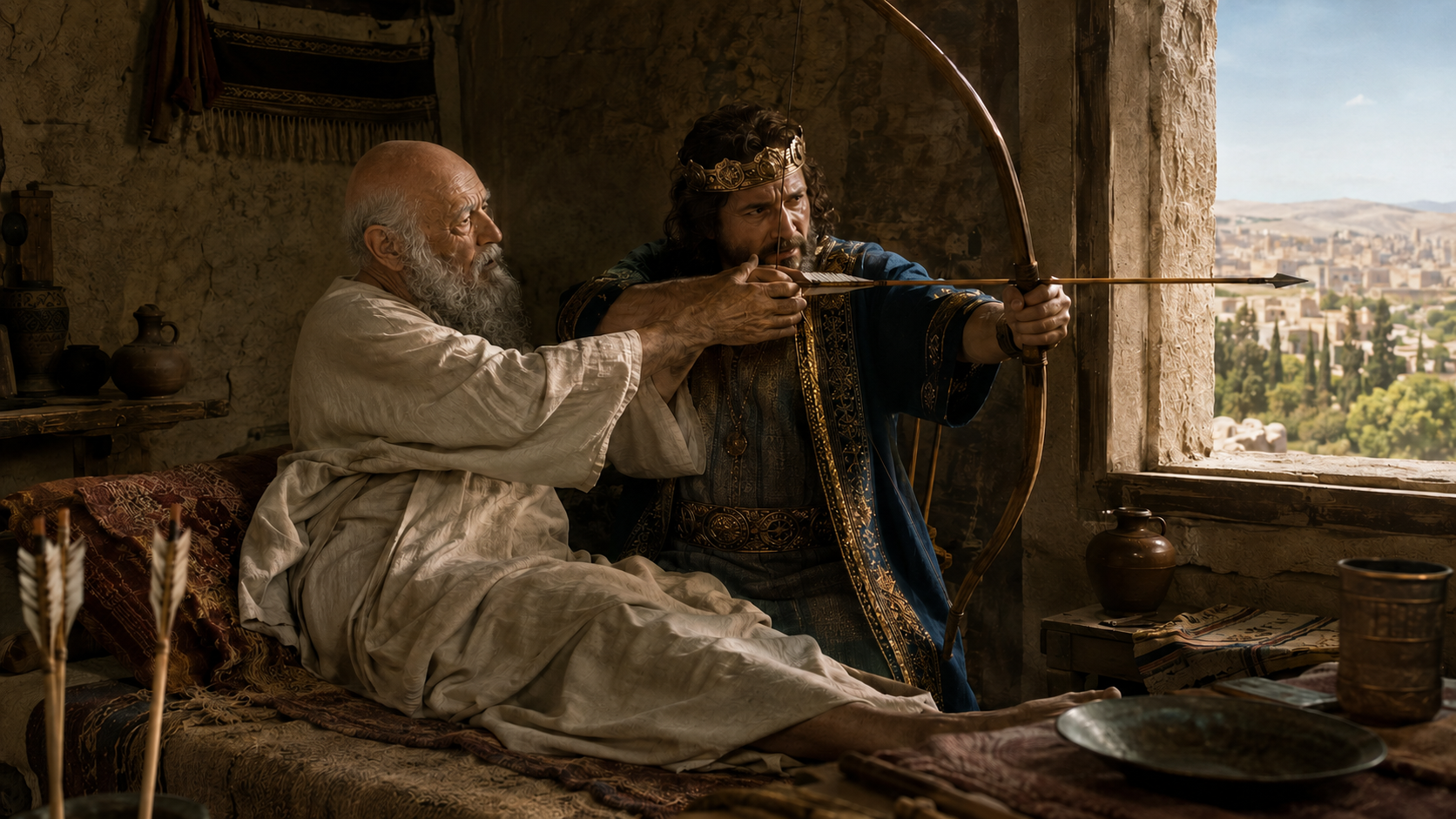
When Elisha became sick with the illness of which he was to die, Joash the king of Israel came down to him, and wept over him and said, “My father, my father, the chariots of Israel and its horsemen!” And Elisha said to him, “Take a bow and arrows.” So he took a bow and arrows. Then Elisha said to the king of Israel, “Lay your hand on the bow.” And he laid his hand on it, then Elisha put his hands on the king’s hands. And he said, “Open the window toward the east,” and he opened it. Then Elisha said, “Shoot!” So he shot. And he said, “The LORD’S arrow of victory, and the arrow of victory over Aram; for you will defeat the Arameans at Aphek until you have put an end to them.” Then he said, “Take the arrows,” and he took them. And he said to the king of Israel, “Strike the ground,” and he struck it three times and stopped. Then the man of God became angry at him and said, “You should have struck five or six times, then you would have struck Aram until you put an end to it. But now you shall strike Aram only three times.”
And Elisha died, and they buried him. Now the marauding bands of the Moabites would invade the land in the spring of the year. And as they were burying a man, behold, they saw a marauding band; and they threw the man into the grave of Elisha. And when the man touched the bones of Elisha, he revived and stood up on his feet.
BACKGROUND
A lot of time has lapsed since our last study in the life of Elisha. Let’s review a quick summary of all that took place in Israel and Judah leading up to Elisha’s death.
Summary of 2 Kings 7–13:13
Major Events in Elisha’s Ministry Before His Death
These chapters record some of the most dramatic miracles, political upheavals, and prophetic acts in Elisha’s ministry. They show God’s power over famine, war, disease, kings, and nations, while demonstrating both His judgment and mercy toward Israel.
The Siege of Samaria Ends Miraculously (2 Kings 7)
The kingdom of Israel was suffering under a severe siege by Aram (Syria). Food became so scarce that famine reached horrific levels. Elisha prophesied that within twenty-four hours, food would become plentiful and inexpensive. An officer of the king doubted the prophecy. That night, God caused the Aramean army to hear the sound of chariots and horses. Believing they were being attacked, they fled in panic, leaving behind their camp, supplies, and wealth. Four lepers discovered the deserted camp and brought the good news to Samaria. The prophecy was fulfilled exactly, and the skeptical officer was trampled to death at the city gate, seeing the blessing but never enjoying it. Key lesson: God’s promises are certain even when circumstances seem impossible.
The Shunammite Woman Restored (2 Kings 8:1–6)
Elisha warned the Shunammite woman whose son had been raised from the dead to leave Israel because of an approaching seven-year famine. After returning years later, she appealed to the king for the restoration of her property. At the very moment she arrived, Gehazi was telling the king about Elisha’s miracles, including the raising of her son. The king restored all her land and income. Key lesson: God’s providence works behind the scenes to care for His faithful people.
Elisha Predicts Hazael’s Rise to Power (2 Kings 8:7–15)
Elisha traveled to Damascus, where King Ben-Hadad of Aram was ill. Hazael was sent to ask whether the king would recover. Elisha foretold that Hazael would become king and would bring terrible suffering upon Israel. He wept because he foresaw the destruction Hazael would cause.
Hazael then murdered Ben-Hadad and seized the throne. Key lesson: God knows future events and remains sovereign even over wicked rulers.
Wicked Kings in Judah (2 Kings 8:16–29)
Jehoram and later Ahaziah ruled Judah. Through marriage alliances with Ahab’s family, they adopted many of the sinful practices of Israel. This set the stage for God’s coming judgment on the house of Ahab.
Jehu Anointed King of Israel (2 Kings 9)
Elisha sent a young prophet to anoint Jehu as king and to commission him to destroy the house of Ahab. Jehu immediately led a revolt. He killed King Joram of Israel, King Ahaziah of Judah, and Queen Jezebel. Jezebel’s death fulfilled Elijah’s earlier prophecy that dogs would devour her body. Key lesson: God’s judgment may be delayed, but it is never forgotten.
The Destruction of Ahab’s Dynasty (2 Kings 10)
Jehu continued his purge by executing Ahab’s seventy sons, many officials and supporters of Ahab, and the worshipers of Baal throughout Israel. He destroyed Baal’s temple and temporarily removed Baal worship from Israel. However, Jehu failed to abandon the golden calf worship established by Jeroboam. Because of his partial obedience, God promised four generations of descendants on Israel’s throne, but Israel continued to decline spiritually. Key lesson: Partial obedience is still disobedience.
Athaliah Usurps Judah’s Throne (2 Kings 11)
After her son Ahaziah died, Athaliah attempted to destroy the royal family and seize power. A young prince named Joash was hidden in the Temple for six years by the priest Jehoiada and his wife. When Joash was seven years old, Jehoiada organized a coup, crowned him king, and executed Athaliah. The people renewed their covenant with God and destroyed Baal worship in Judah. Key lesson: God faithfully preserves the Davidic line through which the Messiah would eventually come.
Joash Repairs the Temple (2 Kings 12)
Under the guidance of Jehoiada, King Joash initiated major repairs to the Temple in Jerusalem.
After Jehoiada’s death, however, Joash drifted spiritually and later compromised with foreign powers. Key lesson: Spiritual leadership greatly influences national faithfulness.
Now we come to the end of Elisha’s life and his final acts of prophecy.
EXAMINATION
(V.14) When Elisha became sick with the illness of which he was to die, Joash the king of Israel came down to him, and wept over him and said, “My father, my father, the chariots of Israel and its horsemen!”
Elisha was likely around 80 when he died. He led a full life of ministry, working with the various kings of Israel, as he did here with Joash. Elisha’s ministry was one of saving, blessing, and influence for the kingdom of God. This was unlike Elijah’s ministry, which was mainly judgment.
There were two previous times that we heard this phrase, the chariots of Israel and its horsemen used about someone. The first time was when Elijah was being taken to heaven. Elisha looked up and cried out the chariots of Israel and its horsemen. The second time was when the army of Aram came to capture Elisha at his home in Dothan. Elisha prayed for his servant’s eyes to be opened, and his servant saw the chariots of Israel and its horsemen all around the city to protect Elisha. Now, King Joash uses this phrase to identify Elisha. He is acknowledging that Elisha is a true prophet of God, even though he himself preferred the worship of Jeroboam’s calves.
We should note here that King Joash, because of this incident with Elisha, seemed to have some type of rudimentary faith in God. This is because he honored Elisha with the special phrase, the chariot of Israel and its horsemen. In addition, kings did not normally visit and wait on prophets. It was usually the other way around. But here, King Joash comes to Elisha to wait and mourn over him. So, he had some tenderness in his heart for the old prophet. King Joash was really not a true worshiper of God, but he had something in him that acknowledged God because of this. As such, Elisha honored him by prophesying in his favor, even on his deathbed. It seems that God will be with us when we are with him, even a little.
(V.15-17) Elisha said to him, “Take a bow and arrows.” So he took a bow and arrows. Then Elisha said to the king of Israel, “Lay your hand on the bow.” And he laid his hand on it, then Elisha put his hands on the king’s hands. And he said, “Open the window toward the east,” and he opened it. Then Elisha said, “Shoot!” So he shot. And he said, “The LORD’S arrow of victory, and the arrow of victory over Aram; for you will defeat the Arameans at Aphek until you have put an end to them.”
Elisha often used symbolic acts to drive home his prophesies. He used a common stick to cause the axe head to float. He used flour to heal the poisoned stew. He used salt to heal a city’s water source, and so on. Again, he uses symbolism to prophesy on the king’s behalf. The arrows, weapons of war, were used symbolically to proclaim victory by Israel over Aram. Because Elisha put his hands on the king’s hands, he was showing that the victory would be of God’s making. His hand would be with Israel. We see this reflected later in the chapter when it says, “The LORD was gracious to them and had compassion on them and turned to them because of His covenant with Abraham, Isaac, and Jacob; and He was unwilling to eliminate them or cast them away from His presence until now” (II Kings 13:23).
God would be with Israel because he loved them.
(V.18-19) Then he said, “Take the arrows,” and he took them. And he said to the king of Israel, “Strike the ground,” and he struck it three times and stopped. Then the man of God became angry at him and said, “You should have struck five or six times, then you would have struck Aram until you put an end to it. But now you shall strike Aram only three times.”
The prophet was angry with King Joash because he didn’t take the symbolism far enough. This meant their victory over Aram would not be complete. They would only defeat them three times. This was fulfilled in verse 25.
(V.20-21) And Elisha died, and they buried him. Now the marauding bands of the Moabites would invade the land in the spring of the year. And as they were burying a man, behold, they saw a marauding band; and they threw the man into the grave of Elisha. And when the man touched the bones of Elisha, he revived and stood up on his feet.
This account takes place one to two years after Elisha’s death, as only his bones were left. Elisha was probably buried in an open grave, like a cave or other such hole where his bones would have been exposed.
There is an esoteric practice that is used by some of the prosperity gospel movement based upon this passage. It is called grave sucking. The idea is for a person who wants to be filled with the Holy Spirit to lie upon the grave of a person who was a godly man or woman, and therefore the spiritual blessings of that person and the filling of their spirit would be imparted to them as they lie upon their grave. This is nothing more than a cultic practice and has nothing to do with true Christianity. This passage was not meant to be prescriptive as to getting the blessings of a dead person. Simply, it was descriptive, showing that the power of Elisha’s ministry continued even after the grave.
What does this short account represent? It represents Israel’s condition before the Lord. Like the dead man, Israel was dead in its sin and idol worship. But, if it heeded the ministry of Elisha, it could be spiritually revived. The same is true with us. Ephesians 2:1 says we are dead in our trespasses and sins. Only contact with the Lord Jesus can revive us from being spiritually dead to being spiritually alive to God.
WHAT HAVE WE LEARNED?
- Even on his deathbed, Elisha was serving in his ministry, prophesying to the king of Israel.
- King Joash honored Elisha, though he did not follow the Lord fully.
- Elijah prophesied favorably for King Joash and his defeat against Aram.
- The power of Elisha’s ministry continued even in death.
INTERPRETATION
What is the author’s big idea?
God will be with you when you are with him.
Because Joash was friendly toward Elisha, God was with him in good favor. This was not the normal way it was with most of the kings of Israel. Elisha showed the king that God would be with him in war against Aram. He showed him that he would defeat them three times on his behalf. And he was even with Elisha in the grave when he revived a dead man.
The scripture says, “For the eyes of the LORD roam throughout the earth, so that He may strongly support those whose heart is completely his” (II Chronicles 16:9). When we devote ourselves fully to the Lord, then the Lord is with us. But if we mix our worship of God with worship of other things or other people, then our relationship with God is limited. God cannot look upon sin. If we consider sin in our hearts, the scripture says the Lord will not hear us (Psalm 66:18).
APPLICATION
As we come to the end of our study of the lives of Elijah and Elisha, this is the most appropriate thing to give consideration to. Are we fully devoted to the Lord in every way? Is Jesus Christ the supreme chief affection of our lives? This is our sole application point for this study, as it is the most important question that we can ask ourselves. Is Jesus Christ the supreme affection of my life?
What is it that you value in your life? When you think of the things that are important to you, what stands out as the most important thing of all? Is it a job? Is it a relationship with someone? Is it your status in life? What is it?
The most important thing in our life should be our relationship with God through Jesus Christ. Everything else in life that we have or experience is temporary. Someday we will die, and it will all be left behind. We cannot take it with us. However, we take our relationship with God with us to the grave and beyond. If we will be with God now, we will be with God for eternity.
Matthew 10:37-39 tells us the cost we must count if we want a true relationship with God. Jesus said, “The one who loves father or mother more than Me is not worthy of Me; and the one who loves son or daughter more than Me is not worthy of Me. And the one who does not take his cross and follow after Me is not worthy of Me. The one who has found his life will lose it, and the one who has lost his life on My account will find it.”
What, or who, is the supreme affection of your life? Make Jesus Christ your complete and total priority in everything, and God will be with you as he was with Elisha and all the prophets and apostles of God.
Consider praying this prayer as we close this study:
“God, I thank you that you have made me, and all humanity, the supreme affection of your life. You gave up everything for us through Jesus Christ. Lord, how can I surrender every part of my life to you that I might make you my supreme affection also? Help me to live for you in everything that I do. Help me to evaluate every part of my life, as to whether or not it is submitted to you and under your leadership. I thank you for what you’re doing in my life. I thank you for calling me to you, for forgiving me, for giving me your salvation, and your Holy Spirit. I love you, Lord. Help me to love you more. Amen.”