II Kings 6:1-7
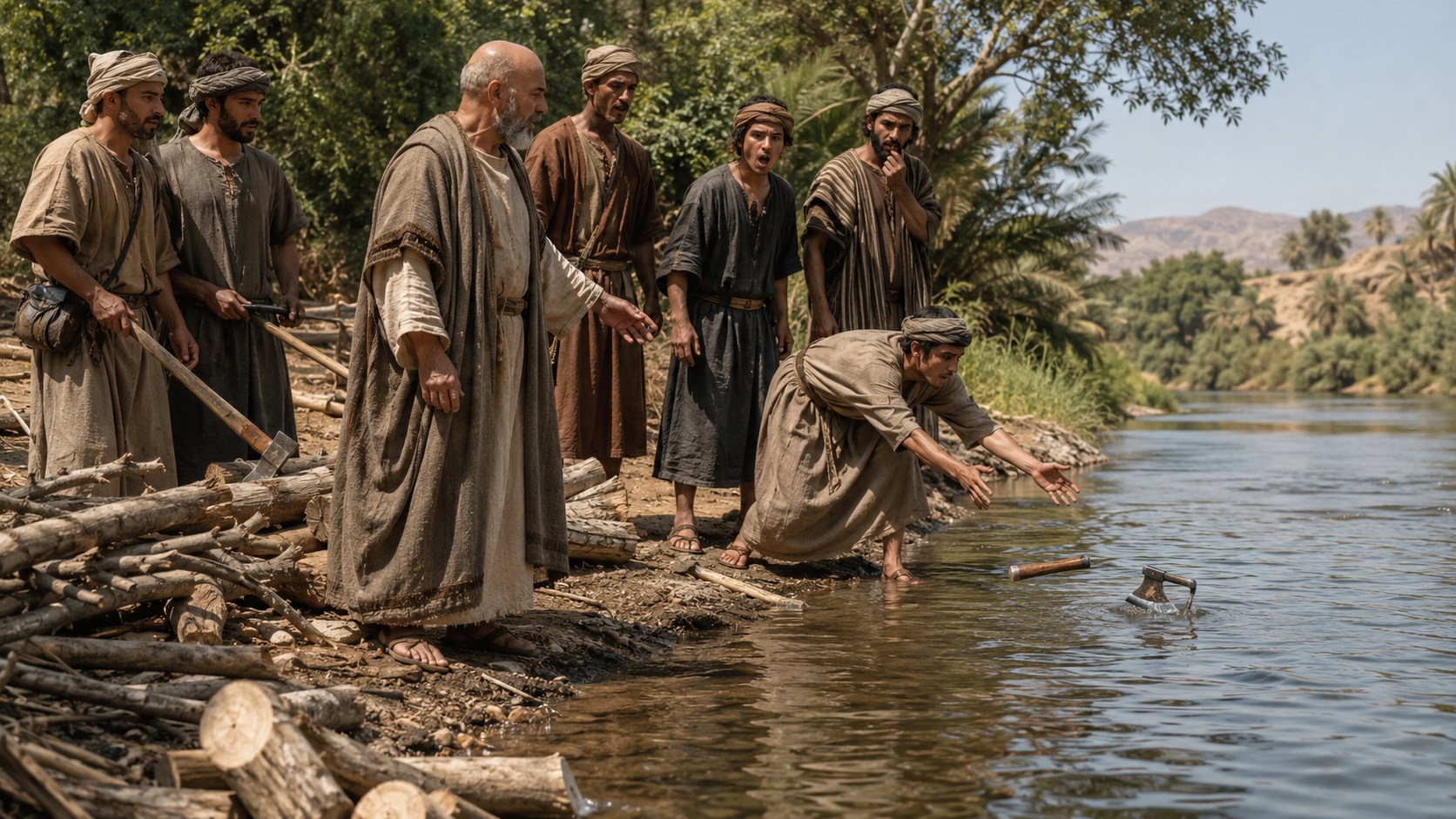
Now the sons of the prophets said to Elisha, “Behold, now, the place before you where we are living is too cramped for us. Please let us go to the Jordan, and let us each take from there a beam, and let us construct a place there for ourselves, to live there.” So he said, “Go.” Then one of them said, “Please agree and go with your servants.” And he said, “I will go.” So he went with them, and when they came to the Jordan, they cut down trees. But it happened that as one of them was cutting down a beam, the axe head fell into the water; and he cried out and said, “Oh, my master! It was borrowed!” Then the man of God said, “Where did it fall?” And when he showed him the place, he cut off a stick and threw it in there, and made the iron float. Then he said, “Pick it up for yourself.” So he reached out his hand and took it.
BACKGROUND
This is a strange story, and admittedly, it is difficult to interpret. To be honest, most commentators that I researched tend to gloss over the story as God simply showing his care and concern for small matters. And I suppose there’s a realm where some of that is true. But I think that scripture, very often, is concerned with larger things. Because of this, I’m going to interpret this passage symbolically. When I do, I think you’ll see the passage’s value beyond God caring for small needs.
What stands out with this story and others before it is that Elisha has a unique relationship with God as a special prophet of God. He’s not simply a prophet. He is the “man of God.” Elisha was endowed with special power because he was filled with the Holy Spirit. There were other prophets during this time, but none could do the miracles that Elisha did. Like Jesus, Elisha was unique. He provides food miraculously. He raises the dead. He makes iron float. No other prophet during this time was doing these things. And all of these miracles and works that Elisha did are of a saving nature. He is saving people. He is saving situations. Saving is the specific work of the Holy Spirit.
So, what does this text mean? Let’s get into our passage verse by verse and see what we can draw from it.
EXAMINATION
(V.1) Now the sons of the prophets said to Elisha, “Behold now, the place before you where we are living is too cramped for us.
As we’ve learned from our previous lessons, the company of the prophets was not some sort of monastic community where people lived in isolation. The prophets had wives. They had families, though they lived together in a single community. This community of prophets probably lived somewhere near Jericho. Clearly, the company of prophets had expanded under the ministry of Elisha so that there were too many of them to live in the place where they were living. They needed to move. They needed to expand their facilities.
(V.2) Please let us go to the Jordan, and let us each take from there a beam, and let us construct a place there for ourselves, to live there.” So he said, “Go.”
The area of the Jordan that they are suggesting to Elisha is a forested area. There would’ve been plenty of wood around for them to build a facility and homes. It was essentially unclaimed territory. Elisha is in agreement that the area where they are currently is too small for them, and so he encourages them to go and build a new facility.
(V.3) Then one of them said, “Please agree and go with your servants.” And he said, “I will go.”
Elisha agrees to go with them. In other words, he will be with them and doing the work of building a new facility, not simply directing things. Elisha was truly a man of the people.
(V.4-5) So he went with them, and when they came to the Jordan, they cut down trees. But it happened that as one of them was cutting down a beam, the axe head fell into the water; and he cried out and said, “Oh, my master! It was borrowed!”
I’d like to quote commentator Jon Courson on this passage. I think he sums it up the best.
“One of the men found himself in a predicament. While he was doing the work of the ministry, the axe head he was using fell in the Jordan River. The axe head in this story is a symbol, a picture of the cutting edge of power, of effectiveness. It speaks of the Holy Spirit. The only way we’ll ever build anything—be it ministry or marriage, families or friendships—is if we build in the power of the Holy Spirit. The Psalmist declares that those who build apart from the Lord labor in vain (127:1). You can follow every principle of marriage, parenting, and ministry, and still fail if you are not doing it in the power of the Holy Ghost, for it is “not by might, nor by power, but by My Spirit saith the Lord” (Zechariah 4:6).
Most metal tools during this period were made of bronze. The fact that there is an iron axe head shows that it has great value. This is true of our relationship with the Holy Spirit. We do not simply have a relationship with God and do things under our own power. We have something of greater value. Each one of us as Christians is filled with the Holy Spirit. He indwells each one of us and empowers the work that we do for the gospel. There is nothing that we can do effectively for Christ without the power of the Holy Spirit. However, there are times when we act in our own flesh, in our own power. It’s like an axe handle without an axe head. Useless. We act without the blessing and the filling of the Holy Spirit. In those times, our work is frustrated. And so we might see some symbolism in this passage of what happens when a person acts without the Holy Spirit. You cannot chop wood without an axe. You cannot do the work of the Spirit without the Spirit.
Note also that the man says the axe head was borrowed. This is also true of our relationship with the Holy Spirit. We do not earn the Spirit’s presence. We do not trade anything for the Spirit’s presence. We do not get anything or give anything for the Holy Spirit’s power in our lives. God gives us the Holy Spirit by grace through faith. He is, in a sense, “borrowed.”
Now, unlike in Old Testament times, the Holy Spirit will not leave us. Once you and I have the Holy Spirit in us, we have a promise from God that he never leaves. However, sometimes we can leave him. That is, we can do the work of God without the power of God. We can ignore and grieve the Holy Spirit. When we sin, we do so without the Holy Spirit. When that happens, we are devoid of his power. We must repent and come back to him in faith.
(V.6) Then the man of God said, “Where did it fall?” And when he showed him the place, he cut off a stick and threw it in there, and made the iron float.
Some commentators have suggested that Elisha stuck a piece of wood into the river to retrieve the axe head. But this is not what the text says. Again, this is another miracle of Elisha. Elisha throws a stick into the water, and the axe head floats. There is nothing miraculous about the stick. What is miraculous is the power that Elisha operates by.
(V.7) Then he said, “Pick it up for yourself.” So he reached out his hand and took it.
The power of the Holy Spirit is available to anyone who comes to faith in Christ. We have simply to move by faith in the power of the Spirit to do whatever it is that God has called us to do. In other words, “pick it up for yourself.”
What are some signs that a person, church, or ministry may be relying more on human effort than on the Holy Spirit?
How can we distinguish between being busy for God and being empowered by God?
In what ways does this passage encourage those who feel they have lost something valuable in their spiritual lives?
WHAT HAVE WE LEARNED?
- The company of the prophets needed to expand their facilities to take care of their needs.
- Elisha went with the prophets to help them build new facilities.
- Like the borrowed axe head, we are given the Holy Spirit in order to live our lives.
- Like an axe handle without an axe head, when we sin or operate under our own power, we are devoid of the Spirit’s power.
- We can again experience the Holy Spirit’s power through repentance and faith.
INTERPRETATION
What is the author’s big idea? We have two points to consider.
- Elisha is a unique prophet of God and is endowed with special power from the Holy Spirit.
- Just like the symbolism of the axe head, God wants to empower all of his people with the power of the Holy Spirit.
All Christians must ask the question, “What does God want me to do with my life?” Whatever it is that God has called you to do, whether in ministry or vocation, you are not alone in your ability to do it. God has given us the Holy Spirit to give us the special power that we need to fulfill his calling. The worker in our story could not chop wood without the axe. So, too, you and I cannot perform the work of ministry without the power of the Holy Spirit. Even in the Old Testament, the Holy Spirit’s power was required for ministry. In Micah 3:8, the scripture says, “I am filled with power— With the Spirit of the LORD— And with justice and courage To make known to Jacob his rebellious act, and to Israel his sin.”
People were also filled with the spirit for other vocational things. As we see in the book of Exodus. “You shall speak to all the skillful people whom I have endowed with the spirit of wisdom, that they make Aaron’s garments to consecrate him, that he may serve as priest to Me” (Exodus 28:3).
The filling and the empowering of the Holy Spirit is the secret, the key, to living the Christian life. Without the Holy Spirit‘s power, we are able to do nothing.
APPLICATION
If you approach the passage symbolically and devotionally, the lost axe head can serve as a picture of losing spiritual effectiveness and the need for the power of the Holy Spirit.
1. Ministry Without the Spirit Loses Its Cutting Edge
An axe without an axe head is little more than a stick. The worker may continue swinging, but nothing significant happens.
Application: It is possible to remain busy in ministry, teaching, or serving while lacking the Spirit’s power and effectiveness. Activity is not the same as spiritual fruitfulness.
“Not by might nor by power, but by My Spirit,” says the Lord (Zechariah 4:6).
2. We Must Be Honest When We Have Lost Our Spiritual Edge
The prophet immediately cried out, “Alas, my master!” He did not pretend everything was fine.
Application: When our passion for Christ, effectiveness in ministry, prayer life, or love for God’s Word declines, the first step is honest confession. We cannot recover what we refuse to acknowledge has been lost.
David prayed, “Restore to me the joy of Your salvation” (Psalm 51:12).
3. God Wants Us to Remember Where We Lost It
Elisha asked, “Where did it fall?”
Application: Spiritual renewal often begins by identifying where our walk with God began to cool. Was it neglect of prayer? Sin? Pride? Distraction? Self-reliance? God often takes us back to the point of loss before restoring us.
4. The Spirit’s Power Cannot Be Manufactured by Human Effort
The young prophet could not dive down and retrieve the axe head himself. The solution required divine intervention.
Application: We cannot produce genuine spiritual power through talent, education, technology, experience, or hard work alone. The effectiveness of our ministry ultimately depends on the work of the Holy Spirit.
5. God Can Restore What Has Been Lost
Through God’s power, the iron floated and was recovered.
Application: If we have lost our spiritual sharpness, usefulness, joy, boldness, or dependence on the Spirit, God is able to restore us. Failure does not have to be final. The Lord delights in renewing His servants and returning them to fruitful service.
“Be filled with the Spirit” (Ephesians 5:18).
REVIEW
In a symbolic sense:
- The axe head represents the Holy Spirit’s power and enabling.
- The handle represents our abilities, gifts, and efforts.
- The loss of the axe head symbolizes spiritual decline and self-reliance.
- Elisha’s question, “Where did it fall?” points to self-examination and repentance.
- The floating axe head illustrates God’s gracious restoration of spiritual power and usefulness.
The lesson is simple: a handle without an axe head cannot cut wood, and a believer attempting to serve God without dependence on the Holy Spirit will eventually discover that effort alone cannot accomplish spiritual work. Jesus Himself said: “Apart from Me you can do nothing” (John 15:5).