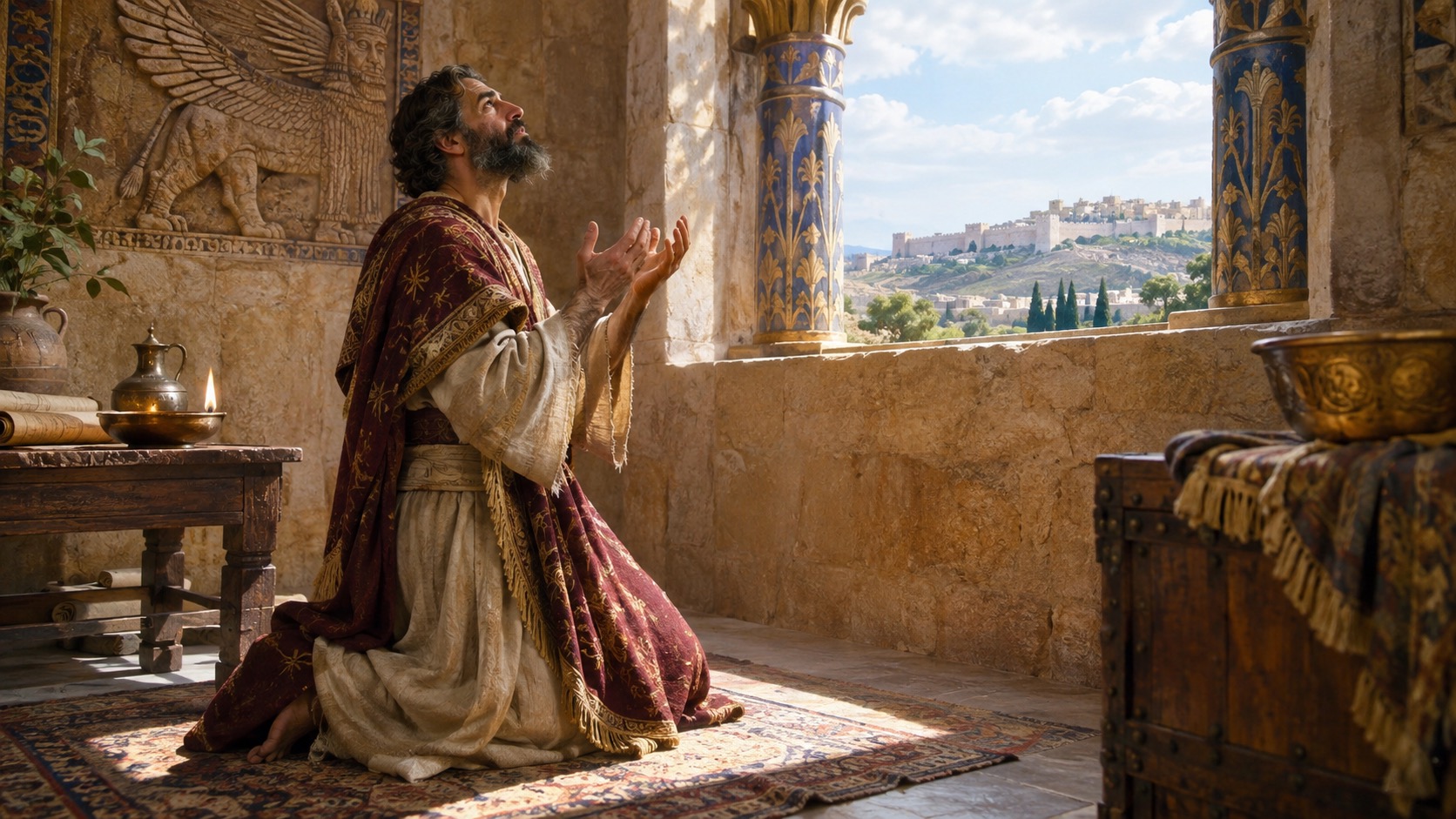
DANIEL 9:1-19
In the first year of Darius the son of Ahasuerus, of Median descent, who was made king over the kingdom of the Chaldeans— in the first year of his reign, I, Daniel, observed in the books the number of the years which was revealed as the word of the LORD to Jeremiah the prophet for the completion of the desolations of Jerusalem, namely, seventy years. So I gave my attention to the Lord God, to seek Him by prayer and pleading, with fasting, sackcloth, and ashes. I prayed to the LORD my God and confessed, and said, “Oh, Lord, the great and awesome God, who keeps His covenant and faithfulness for those who love Him and keep His commandments, we have sinned, we have done wrong, and acted wickedly and rebelled, even turning aside from Your commandments and ordinances. Moreover, we have not listened to Your servants the prophets, who spoke in Your name to our kings, our leaders, our fathers, and all the people of the land.
“Righteousness belongs to You, Lord, but to us open shame, as it is this day—to the men of Judah, the inhabitants of Jerusalem, and all Israel, those who are nearby and those who are far away in all the countries to which You have driven them, because of their unfaithful deeds which they have committed against You. Open shame belongs to us, LORD, to our kings, our leaders, and our fathers, because we have sinned against You. To the Lord our God belong compassion and forgiveness, because we have rebelled against Him; and we have not obeyed the voice of the LORD our God, to walk in His teachings which He set before us through His servants the prophets. Indeed, all Israel has violated Your Law and turned aside, not obeying Your voice; so the curse has gushed forth on us, along with the oath which is written in the Law of Moses the servant of God, because we have sinned against Him. So He has confirmed His words which He had spoken against us and against our rulers who ruled us, to bring on us great disaster; for under the entire heaven there has not been done anything like what was done in Jerusalem. Just as it is written in the Law of Moses, all this disaster has come on us; yet we have not sought the favor of the LORD our God by turning from our wrongdoing and giving attention to Your truth. So the LORD has kept the disaster in store and brought it on us; for the LORD our God is righteous with respect to all His deeds which He has done, but we have not obeyed His voice.
“And now, Lord, our God, You who brought Your people out of the land of Egypt with a mighty hand and made a name for Yourself, as it is this day—we have sinned, we have been wicked. Lord, in accordance with all Your righteous acts, let now Your anger and Your wrath turn away from Your city Jerusalem, Your holy mountain; for because of our sins and the wrongdoings of our fathers, Jerusalem and Your people have become an object of taunting to all those around us. So now, our God, listen to the prayer of Your servant and to his pleas, and for Your sake, Lord, let Your face shine on Your desolate sanctuary. My God, incline Your ear and hear! Open Your eyes and see our desolations and the city which is called by Your name; for we are not presenting our pleas before You based on any merits of our own, but based on Your great compassion. Lord, hear! Lord, forgive! Lord, listen and take action! For Your own sake, my God, do not delay, because Your city and Your people are called by Your name.”
WHAT IS DANIEL PRAYING FOR IN THIS PASSAGE? BE SPECIFIC.
BACKGROUND
Daniel’s prayer is a prayer of restoration. Prayers of restoration are appeals to God to renew what has been damaged or lost through sin, rebellion, suffering, or spiritual decline. Throughout Scripture, God invites His people to return to Him through repentance, confession, and renewed obedience.
1. Restoration Begins with Repentance.
In Deuteronomy 30:1–5, God promises to restore Israel after exile if His people return to Him with all their hearts. Restoration begins with acknowledging sin and turning back to God.
2. Restoration Requires Confession.
In Daniel 9:3–19, Daniel confesses Israel’s sins and pleads for God’s mercy. Although Daniel was personally faithful, he identifies himself with his nation’s failures and asks God to restore Jerusalem.
3. Restoration Depends on God’s Mercy.
In Psalm 51:10–12, David asks God to create a clean heart within him and restore the joy of salvation. His prayer demonstrates that spiritual restoration is an act of divine grace, not human achievement.
4. Restoration Seeks Renewed Fellowship with God.
In Psalm 80:3, Asaph prays, “Restore us, O God; let your face shine, that we may be saved!” The ultimate purpose of restoration is not merely recovering lost blessings but renewing fellowship with God.
5. Restoration Leads to Renewed Obedience.
In Nehemiah 1:4–11, Nehemiah confesses Israel’s sins and appeals to God’s covenant promises. His prayer leads to action as he participates in rebuilding Jerusalem.
The Central Lesson—biblical restoration is more than recovering what was lost. It is returning to the God from whom we have wandered. Prayers of restoration recognize God’s holiness, confess human failure, appeal to His mercy, and seek a renewed relationship characterized by faith and obedience.
Key Scripture: Lamentations 5:21 (ESV)
“Restore us to yourself, O LORD, that we may be restored! Renew our days as of old.”
EXAMINATION
(V.2-3) I, Daniel, observed in the books the number of the years which was revealed as the word of the LORD to Jeremiah the prophet for the completion of the desolations of Jerusalem, namely, seventy years. So I gave my attention to the Lord God, to seek Him by prayer…”
WHAT MOTIVATED DANIEL TO PRAY?
In our previous studies, we’ve seen that prayer is not initiated by us, but by the Lord. This is true in this passage as well. Daniel was giving his attention to the Scripture when he was convicted to pray for Jerusalem. Daniel noticed that the Lord made certain promises about restoring his people after seventy years of captivity. Essentially, Daniel prays for God to fulfill his word.
(V.3) So I gave my attention to the Lord God, to seek Him by prayer and pleading, with fasting, sackcloth, and ashes.
Daniel doesn’t merely pray a few things and say amen. He turns his full attention, his heart, his mind, and even his body to seek the Lord. Prayer and pleading denote the depth of the heart. He is deeply involved from his heart, seeking the Lord. Fasting, sackcloth, and ashes involve the body. He denied himself food to seek the Lord instead. Sackcloth was a rough material, uncomfortable to wear. He puts himself in discomfort to sacrifice his comfort to the Lord. Ashes represent mourning. Ashes would be thrown on the head. In every way, Daniel is in mourning and sacrifice in his prayer, giving everything to seek the Lord’s answer to his prayers.
(V.4) I prayed to the LORD my God and confessed, and said, “Oh, Lord, the great and awesome God, who keeps His covenant and faithfulness for those who love Him and keep His commandments…
HOW DOES DANIEL BEGIN HIS PRAYER, WHAT DOES HE START WITH?
Daniel begins with praise, saying, “the great and awesome God.” He praises God for his character. “Who keeps his covenant and faithfulness.”
(V.5) …we have sinned, we have done wrong, and acted wickedly and rebelled, even turning aside from Your commandments and ordinances.
Then he turns to confession, confessing the sins of his people. He confesses four things: (1) wrong, (2) wickedness, (3) rebellion, and (4) turning aside. He says Israel hasn’t merely sinned, but turned away from God totally, acting worthy of God’s wrath against them. Additionally, Daniel is specific in his confession. He also prays as if he is guilty, by saying “we.” He identifies with his people’s sin.
(V.6) Moreover, we have not listened to Your servants the prophets, who spoke in Your name to our kings, our leaders, our fathers, and all the people of the land.
When the Lord sought to return Israel to him, the people ignored the warnings of the prophets who tried to bring them back into relationship with the Lord. Kings, leaders, and fathers denote all of the leadership of Israel, from political leaders (kings), to societal leaders (leaders), to family leaders (fathers). There was no part of society that was not in rebellion against the Lord.
(V.8-10) Open shame belongs to us, LORD, to our kings, our leaders, and our fathers, because we have sinned against You. To the Lord our God belong compassion and forgiveness, because we have rebelled against Him; and we have not obeyed the voice of the LORD our God, to walk in His teachings which He set before us through His servants the prophets.
WHAT DOES IT MEAN TO HAVE SHAME?
Open shame refers to the punishment the people endured for their rebellion. Through Jeremiah, the Lord warned Judah that they would become a byword to other nations, that they would carry shame for their sin in front of other peoples. Their reputation was that their God had punished them for their sin. But notice what else Daniel says.
“To the Lord our God belong compassion and forgiveness,” get this, “because we have rebelled against him…” He doesn’t say for forgiveness because they repented. He ascribes forgiveness to the guilty. Daniel is counting on God’s mercy for his people because that’s what he promised. He promised this is Jeremiah 29:10-14, which is the passage Daniel was reading.
“For this is what the LORD says: ‘When seventy years have been completed for Babylon, I will visit you and fulfill My good word to you, to bring you back to this place. For I know the plans that I have for you,’ declares the LORD, ‘plans for prosperity and not for disaster, to give you a future and a hope. Then you will call upon Me and come and pray to Me, and I will listen to you. And you will seek Me and find Me when you search for Me with all your heart. I will let Myself be found by you,’ declares the LORD, ‘and I will restore your fortunes and gather you from all the nations and all the places where I have driven you,’ declares the LORD, ‘and I will bring you back to the place from where I sent you into exile.’”
Daniel continues his confession.
(V.13) Just as it is written in the Law of Moses, all this disaster has come on us; yet we have not sought the favor of the LORD our God by turning from our wrongdoing and giving attention to Your truth.
Daniel says that Israel has not yet repented. Yet he is counting on God’s forgiveness for his people. Notice why he says this has come upon them. It was written in the law of Moses. In other words, long before Israel had rebelled, God said they would rebel and that he would drive them out of their land. He promised this in Deuteronomy 28:63-64.
“And as the LORD took delight in doing you good and multiplying you, so the LORD will take delight in bringing ruin upon you and destroying you. And you shall be plucked off the land that you are entering to take possession of it. And the LORD will scatter you among all peoples, from one end of the earth to the other…”
The point is that Daniel is praying through the scripture of what God said previously he would do if Israel rebelled, and then his promise of restoration. This is important for us. Praying through God’s promises is one way of guaranteeing an answer to our prayers. Daniel is saying, “You did what you promised you would do; now, Lord, please do it again.” Then look what Daniel says.
(V.16) Lord, in accordance with all Your righteous acts, let now Your anger and Your wrath turn away from Your city Jerusalem, Your holy mountain; for because of our sins and the wrongdoings of our fathers, Jerusalem and Your people have become an object of taunting to all those around us.
DANIEL IS ASKING GOD TO ACT BASED UPON WHAT? WHY DOES HE DO THAT?
Daniel builds upon God’s promises by asking God to move according to his “righteous acts.” He wants God’s judgment lifted from Jerusalem, from his people. Daniel is asking God to remove their shame. Notice the phrase, “object of taunting.”
The Near East at this time was organized around what is called a shame-honor dynamic. To suffer public shame was the worst that could happen to you. For many, to live with shame was worse than death. Jerusalem and Israel were living, as Daniel previously said, in “open shame.” This is still true in some cultures today.
I have a friend in a Muslim country who had a disagreement with a contractor he hired to fix his home. So the contractor beat him in front of his kids. The beating was not the bad part. Doing in front of his children brought him open shame he could not live down. That was worse than the beating.
Daniel is asking God to remove their shame and restore their honor. Look at the next verse.
(V.17-18) So now, our God, listen to the prayer of Your servant and to his pleas, and for Your sake, Lord, let Your face shine on Your desolate sanctuary. My God, incline Your ear and hear! Open Your eyes and see our desolations and the city which is called by Your name; for we are not presenting our pleas before You based on any merits of our own, but based on Your great compassion.
He says, “Let your face shine on your desolate sanctuary.” That is a request for restored honor. But notice that there is still no indication of asking this because of repentance. Daniel says they have no merits of their own. He wants God to act based solely on his compassion. We don’t deserve it, Lord, but please do it anyway because you are good.
(V.19) Lord, hear! Lord, forgive! Lord, listen and take action! For Your own sake, my God, do not delay, because Your city and Your people are called by Your name.
He repeats the reason for God to act. “For your own sake.” This tells us that while Daniel was concerned for his people, his greatest concern was for God’s reputation. He says, “Your people are called by your name.” It’s God’s name and reputation that Daniel is primarily concerned with. That has been true throughout his whole prayer. He prayed based upon God’s promises. He recited to God his own words and that he was good to Israel though they rebelled against him. He refers to God’s punishment of them as righteous. He knows Israel is in shame, but he wants God to be honored. God’s honor is Daniel’s first concern.
INTERPRETATION
What is the author’s big idea?
God restores his people based upon his own honor and goodness. He will act to honor his name. Therefore, pray according to God’s acts and promises.
When we read the Bible, we tend to think of its stories as stories about various righteous people, their failures and successes. But this view is only partially correct. The central character in the Bible’s story is the Lord. Thus, our focus when reading Scripture should be on learning how the Lord works, moves, acts, and speaks. He does what he does to honor his name and bring glory to himself. Daniel understood this when he prayed his prayer of restoration. He constantly referred to God’s promises, God’s righteous acts, and his goodness and compassion.
Moving the heart of God is not a matter of speaking about our goodness, desires, or even our repentance. It’s a matter of understanding God’s glory. He deserves our obedience because he is worthy of it. Daniel asked for God to act to preserve his good name, not Israel’s. Yes, he wanted restored honor for Israel, but only because he wanted to honor God’s name.
APPLICATION
When seeking God to act, look for promises in his word that apply to your situation. Pray according to those promises. This doesn’t mean we can claim any scripture as a promise for ourselves. Rather, we should pray according to God’s character. How is God’s holy and good character worked out in our prayers? How do we honor him first?
The seriousness of your prayer should be reflected in how you act. Daniel denied himself food, made himself uncomfortable, and he mourned to demonstrate how serious he was about his request. Self-denial is an important part of prayer, especially when we are grieved over our sin or the sin of those we love. God responds to heartfelt, impassioned self-denial.
When you confess your sin, be specific. Don’t merely say, “I have sinned.” Spell out what you did. Feel the weight of it. Daniel was specific in his prayers about Israel’s sin. He talked about wickedness, rebellion, and turning away. Being specific about our sin demonstrates that we are serious about repentance. We confess our shame when we really feel it.
Go back to his promises again. God promises forgiveness and restoration when our heart is rightly positioned, and we openly express our shame. Rely upon what God has already said in his word about what he will do when we confess.
Remember that in the end it’s not about you; it’s about him. We seek God to honor his name and give him glory. It’s about his reputation more than ours. It’s like love for any person. When we love someone, truly love someone, we put their needs and desires first, above our own. Jesus did this for us on the cross. He gave up his life through great pain, suffering, and shame, for us. Therefore, we should act reciprocally. Put God’s name and reputation first. He will be glorified, and act accordingly.