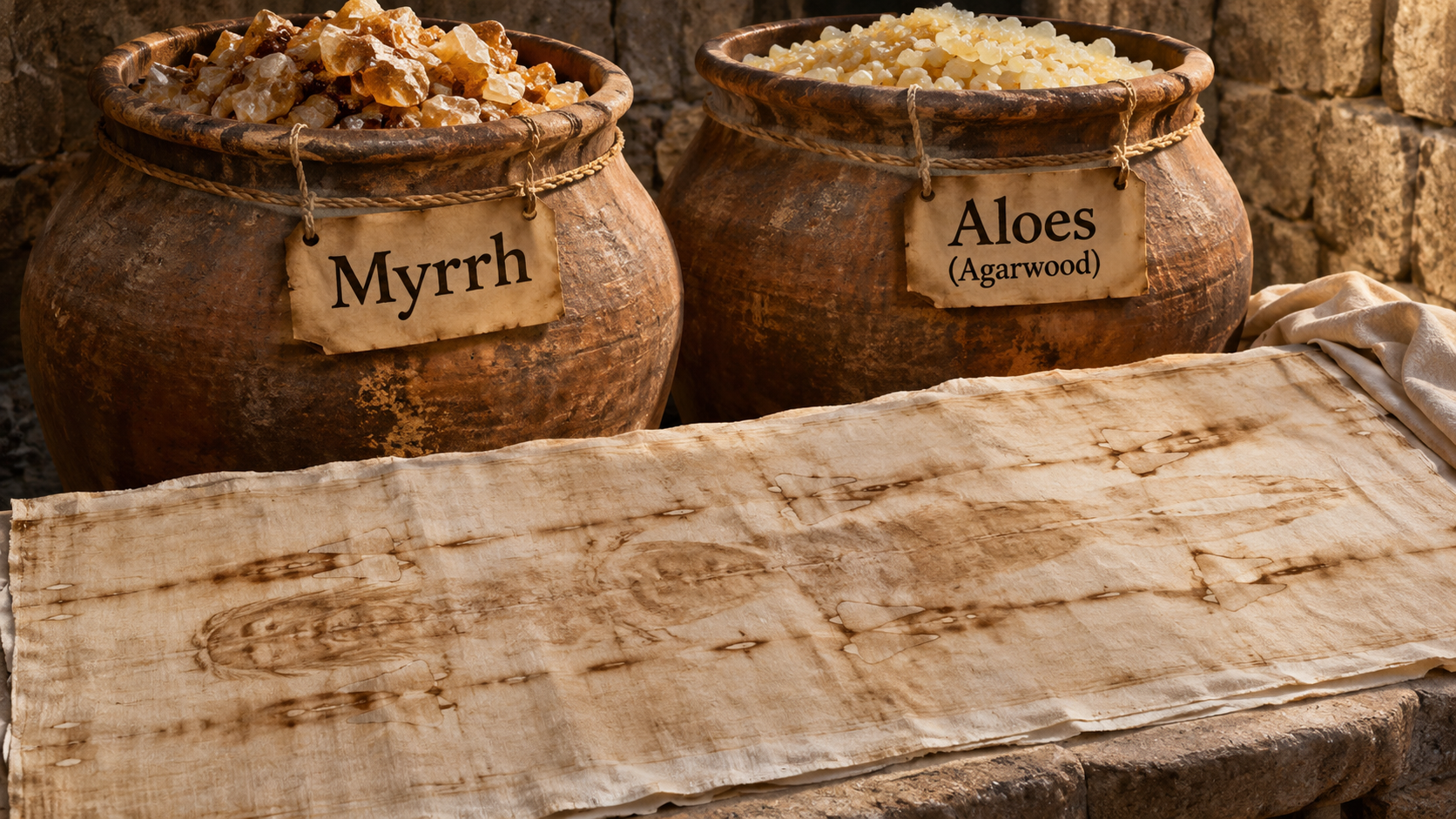
I asked A.I. the following questions: What would 75 pounds of spices have done to the Shroud of Turin? Is there any evidence that these spices were on the shroud?
Here was the answer:
The question of burial spices is an important one when examining the authenticity of the Shroud of Turin. If the shroud is indeed the burial cloth of Jesus, we might reasonably expect some physical or chemical evidence of the burial preparations described in John’s Gospel.
1. What spices were used to bury Jesus?
John 19:39–40 tells us that Nicodemus brought a mixture of myrrh and aloes, weighing about one hundred Roman pounds, equivalent to approximately 72–75 modern pounds.
These were two different aromatic substances:
- Myrrh: An aromatic, reddish-brown resin obtained from trees of the genus Commiphora.
- Aloes: Most likely fragrant agarwood or another aromatic wood, rather than the medicinal aloe vera plant.
These substances were used to honor the deceased and help mask the odors associated with decomposition. Jewish burial practices differed from Egyptian embalming.
2. What would 75 pounds of spices have done to the shroud?
Depending upon how the spices were prepared and applied, we might expect several effects:
- Yellowish or brownish discoloration of the linen.
- Resin deposits adhering to individual linen fibers.
- Microscopic particles of aromatic wood.
- Organic chemical residues from the myrrh.
- Uneven staining where the spices came into contact with bodily fluids.
However, John does not specify whether the entire quantity was placed directly against Jesus’ body, distributed among the burial linens, or deposited around the body. Nor does he specify whether the substances were dry, powdered, or mixed with liquids. These differences would substantially affect the residues left behind.
3. Is there evidence of myrrh and aloes on the Shroud?
The scientific findings are conflicting, although the most extensive direct scientific examination failed to find evidence of burial spices.
The 1978 Shroud of Turin Research Project (STURP)
Scientists examined the Shroud for five days, collecting 32 adhesive-tape samples from various portions of the cloth.
In their 1982 paper, Physics and Chemistry of the Shroud of Turin, L. A. Schwalbe and Raymond Rogers reported that their findings did not support the presence of myrrh, aloes or skin oils. Mass spectrometry detected no foreign materials on the image fibers.
The 1980 experiments of Samuel Pellicori
Pellicori conducted experiments applying burial substances to linen. His findings included the following:
- Linen treated with myrrh tincture and heated exhibited thoroughly stained fibers.
- Linen treated with aloes exhibited small brown particles.
- Microscopic examination of the Shroud failed to confirm the presence of either substance.
Other reported findings
Other researchers have claimed to identify microscopic particles of myrrh and aloes using optical microscopy and immunofluorescence. However, immunofluorescence testing of fibers without attached particles also produced negative results.
These findings have not established conclusively that the Shroud was treated with burial spices, much less that any particles originated in a first-century burial.
A 2025 scientific review
A scientific review published in the journal Textiles reaffirmed that none of the STURP investigations successfully detected burial spices.
4. Could the spices have disappeared over 2,000 years?
There are several possible explanations for the absence of detectable burial spices.
| Possible explanation | Assessment |
|---|---|
| Natural chemical degradation | Plausible over many centuries. |
| The fire of 1532 | Heat may have degraded some organic compounds. |
| Water used to extinguish the fire | Could have removed some soluble residues. |
| Spices placed outside the main burial cloth | Possible, but not established by Scripture. |
| Spices applied in dry form | May have produced less staining than liquid preparations. |
| Limited scientific sampling | Testing may have missed localized deposits. |
| The Shroud is not Jesus’ burial cloth | A legitimate explanation that must also be considered. |
None of these explanations has been demonstrated to account fully for the absence of spices.
5. Does the absence of spices argue against the Shroud’s authenticity?
I would consider it a legitimate objection to the Shroud’s authenticity, particularly because of the enormous quantity of spices described in John.
John 19:40 explicitly associates three things:
- The body of Jesus.
- The linen burial cloths.
- The burial spices.
Seventy-five pounds is a substantial quantity of aromatic material. Even if only a small percentage came into direct contact with the linen, it would be reasonable to expect some physical or chemical residue, at least initially.
Furthermore, some proponents of the Shroud argue that Jesus was buried hurriedly before the beginning of the Sabbath and that his burial preparations were incomplete. However, John explicitly states that the spices were used, not merely purchased or brought to the tomb.
Conclusion: The absence of scientifically confirmed myrrh and aloes represents a significant unanswered question for proponents of the Shroud’s authenticity. It does not independently disprove its authenticity, but neither can the burial spices be presented as reliable scientific evidence supporting it.
A modern chemical analysis specifically targeting ancient myrrh and agarwood resin biomarkers across multiple areas of the Shroud would be a worthwhile investigation.