
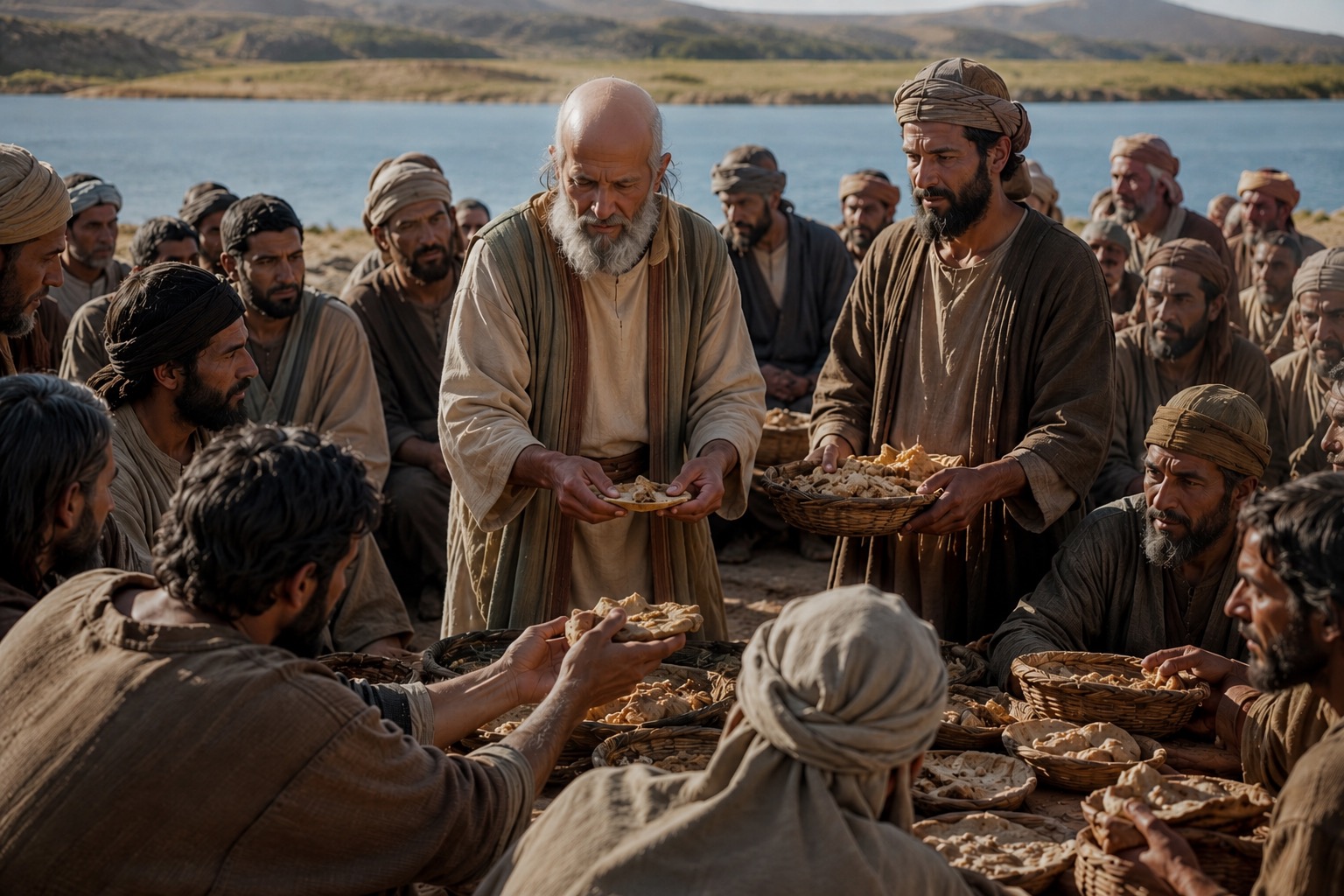
II Kings 4:38-44
WHAT PERSPECTIVE OR ATTITUDE DO YOU FIND YOURSELF TAKING DURING DIFFICULT TIMES?
38When Elisha returned to Gilgal, there was a famine in the land. As the sons of the prophets were sitting in front of him, he said to his servant, “Put on the large pot and boil stew for the sons of the prophets.” 39Then one went out into the field to gather mallow, and found a wild vine and gathered from it his lap full of wild gourds; and he came and sliced them into the pot of stew, because they did not know what they were. 40So they poured it out for the men to eat. But as they were eating the stew, they cried out and said, “You man of God, there is death in the pot!” And they were unable to eat. 41Then he said, “Bring flour.” And he threw it into the pot, and said, “Pour it out for the people that they may eat.” Then there was nothing harmful in the pot.
42Now a man came from Baal-shalishah, and brought the man of God bread of the first fruits, twenty loaves of barley and fresh grain in his sack. And Elisha said, “Give them to the people that they may eat.” 43But his attendant said, “How am I to serve this to a hundred men?” Nevertheless, he said, “Give them to the people that they may eat, for this is what the LORD says: ‘They shall eat and have some left over.’” 44So he served it to them, and they ate and had some left over, in accordance with the word of the LORD.
WHAT IS A SPIRITUAL FAMINE AND HOW DO YOU OVERCOME IT?
BACKGROUND
Our passage today deals with miracles of food. Food is not merely for sustenance. In scripture, it is filled with spiritual meaning and representations, as we will see in today’s passage. So, it’s appropriate to spend some time looking at food in scripture and what it often represents.
Food in scripture operates on multiple levels—as physical sustenance, spiritual metaphor, and social bond—revealing how deeply eating connects human life to God’s purposes.
The principle that “man does not live by bread alone, but man lives by everything that proceeds out of the mouth of the LORD” (Deuteronomy 8:3) establishes food’s fundamental limitation. The absence of God’s life-giving word may cause a famine as severe as any lack of food. [1] This reframing appears throughout scripture: Jesus says that his food is to do the will of God [1], and spiritual teaching is sometimes likened to food—basic teaching is like milk for newborn infants, while deeper teaching is like solid food for mature disciples. [1]
Jesus identifies himself as “the bread of life; he who comes to Me will not hunger, and he who believes in Me will never thirst.” (John 6:35) He describes himself as “the living bread that came down out of heaven; if anyone eats of this bread, he will live forever.” (John 6:48–51) This imagery transforms the ancient manna narrative into a christological claim about eternal sustenance.
Food creates and expresses community. An agreement or reconciliation reached between parties was frequently sealed and celebrated with eating and drinking together, and sharing a meal was in antiquity often an expression of mutual fellowship and trust. [2] The bread broken in communion is a sharing in the body of Christ, and since there is one bread, those who partake become one body. (1 Corinthians 10:16–17) Jesus’ meals with “sinners and tax collectors” and meal scenes both subvert social convention and act out an inclusive vision of the kingdom of God. [3]
Jesus frequently uses banquets as a favorite image for the kingdom of God [1], pointing toward a great feast which the Lord will prepare on Mt. Zion, with the best of foods and wines, and with all the nations of the world sharing in it—symbolically expressing the prophetic hope of the golden age to come, when suffering and mourning, sin and death, will be banished forever. [2]
God’s command to Adam regarding the tree of knowledge—“From any tree of the garden you may eat freely; but from the tree of the knowledge of good and evil you shall not eat” (Genesis 2:16–17)—establishes obedience through food restriction. The actual fall from grace occurs in connection with Adam and Eve’s eating from the tree of the knowledge of good and evil, representing humanity’s sinful determination to set for itself the standard of right and wrong. [2]
EXAMINATION
(V.38) When Elisha returned to Gilgal, there was a famine in the land. As the sons of the prophets were sitting in front of him, he said to his servant, “Put on the large pot and boil stew for the sons of the prophets.”
We begin by noting that the stories told of Elisha’s ministry aren’t necessarily in chronological order, but are arranged thematically to drive home certain points. In this case, the points may be about Baalism and false idol worship, which we will get to in a moment. In II Kings 8:1, God called for a famine in the land. “Elisha spoke to the woman whose son he had restored to life, saying, ‘Arise and go with your household, and sojourn wherever you can sojourn; for the Lord has called for a famine, and it will even come on the land for seven years.’” Famine was part of the curse if Israel abandoned Yahweh worship. In fact, in scripture, famine is sometimes representative of spiritual famine, a lack of spiritual truth or the word of God.
The sons of the prophets were probably the prophetic school that was gathered before Elisha, whom he had come to see. They also would have been living under the famine. Though food was scarce, Elisha ordered some stew to be made. The large pot, here, may represent Israel. We’ll get to that in a moment.
(V.39) Then one went out into the field to gather mallow, and found a wild vine and gathered from it his lap full of wild gourds; and he came and sliced them into the pot of stew, because they did not know what they were.
It’s interesting that the prophet would gather and chop into the stew something that he did not know what it was. Would you do that? Many times, when living in Mongolia, we would see a fruit or a vegetable in the store that we did not recognize. It never occurred to us to buy it and eat it until someone told us what they were and, in some cases, how to prepare them. But here, this prophet takes a plant he’s unfamiliar with and chops it into the stew. This is just like Israel and the worship of Baalism and the golden calves. They knew of Baalism from the surrounding nations, but didn’t know just how damaging it would be to their society.
What are some “harmful ingredients” people unintentionally allow into their lives today, and how can spiritual discernment help protect us?
(V.40) So they poured it out for the men to eat. But as they were eating the stew, they cried out and said, “You man of God, there is death in the pot!” And they were unable to eat.
Scholars have come to the conclusion that the gourd that was chopped into the stew was probably colocynth, “which is a gourd-like plant that creeps along the ground, and has a round yellow fruit the size of a large orange. This fruit is exceedingly bitter, produces colic, and affects the nerves.” [4] Eating the fruit has been known to cause death. Upon eating, colocynth produces abdominal pain and can be fatal. They probably tasted the bitterness and felt the first stomach pains and then proclaimed that there was death in the pot.
Baalism was a spiritual death in the pot of Israel. Israel was dying spiritually because of Baal and golden calf worship.
(V.41) Then he said, “Bring flour.” And he threw it into the pot, and said, “Pour it out for the people that they may eat.” Then there was nothing harmful in the pot.
What does this brief story represent? It may represent the condition of Israel at this time. The pot, as mentioned before, may represent Israel. The northern kingdom of Israel was living in rebellion against God. Just like the poisonous gourds, the people engaged in the spiritual poison of Baalism and worshipping the golden calves. “There is death in the pot,” they said. So too, there was spiritual death in the idol worship they engaged in. The true religion of Yahweh, the word of God, represented by the flour, would cure their spiritual condition.
(V.42) Now a man came from Baal-shalishah, and brought the man of God bread of the first fruits, twenty loaves of barley and fresh grain in his sack. And Elisha said, “Give them to the people that they may eat.”
The man from Baal-Shalishah would normally have brought the first fruits of his offering to the Levitical priests, but he bypassed this rule. Deuteronomy 18:4-5 says, “You shall give him the first fruits of your grain, your new wine, and your oil, and the first shearing of your sheep. For the Lord your God has chosen him and his sons from all your tribes, to stand and serve in the name of the Lord forever.” The problem was that there were no Levitical priests in the northern kingdom because King Jeroboam had years earlier expelled the Levites from serving as priests in the northern kingdom when he set up his own religion of the golden calves. So this man brought his offering to the prophet instead. Here is a man, living in apostate Israel, who seeks to obey God’s law by bringing his first fruits. He finds in the prophet Elisha a fitting substitute.
Verse 38 says there was a famine in the land, so his offering may not have been much. Not enough to feed but a few people, certainly not 100.
The word loaves in this passage does not mean loaves like we are familiar with from a grocery store. This refers to small rolls, enough for one person each, maybe less. Though this man’s offering was given from the heart in obedience to the law, because of the famine, he did not have much to give.
(V.43-44) But his attendant said, “How am I to serve this to a hundred men?” Nevertheless, he said, “Give them to the people that they may eat, for this is what the LORD says: ‘They shall eat and have some left over.’”So he served it to them, and they ate and had some left over, in accordance with the word of the LORD.
Both miracles took place during a famine. How can seasons of hardship, limitation, or uncertainty deepen a person’s faith and dependence upon God?
Does this miracle sound familiar? It is very much like Jesus feeding the 5,000 and the 4,000. The difference being that while Elisha’s miracle fed 100, Jesus’ miracles fed thousands. Jesus’ miracle of the loaves and fish ties him to Elisha in that Elisha’s ministry was a type and precursor to Jesus’ ministry. In both cases, they had some left over.
Here is another slap in the face to Baalism in Israel. Baal was the fertility god who was supposed to multiply crops. The famine was a sign that Baal was false and had no real power. Yet, God is able to multiply food even after it has been harvested and offered. God was again showing his power over Baal.
The two passages we’ve looked at today are connected as a contrast. One represents the spiritual harm and death of Baalism, and the other shows God’s blessing of life for those who follow him, as the man from Baal-Shalishah did. One multiplies death, one multiplies life.
WHAT HAVE WE LEARNED?
- The famine in Israel was representative of a famine of spiritual truth.
- Israel, trapped in spiritual deception, was dying, like those who ate the stew.
- God still requires faithfulness, like in the man from Baal-Shalishah.
- God multiplies faithfulness as he did the food for the community.
INTERPRETATION
What is the author’s big idea?
False religion kills; true faith in God imparts life.
Commentator John Courson makes an interesting observation about our passage.
“Like Elisha’s students, we live in a time of drought—not geologically, but spiritually—due to the fact that so few churches teach the Word of God. In addition to the drought, however, there are all kinds of poisonous winds of doctrine being put in the pot, new fads, and Christian trends. Our job is not to try to pick out the poison in the pot. Our job is to pour in the meal. Stay in the scriptures. Study the word faithfully, consistently, and daily. And as you study the word of God, the poison dissipates.” [5]
Notice the contrasts in our passage. Poisoned food and a food offering. Bitterness and death compared to obedience and life. A miracle to restore and a miracle to multiply blessings. The first story represents a disobedient Israel taking in spiritual poison. The second story represents an obedient few who achieve the blessings of life. It is a contrast of spiritual death next to spiritual life.
APPLICATION
God Can Turn Death Into Life
In the first miracle, poisonous stew brought danger and fear to the prophets, but God used Elisha to make the food safe. This reminds believers that God can redeem situations that seem ruined or dangerous. He is able to bring healing, restoration, and hope where there is spiritual, emotional, or physical “death.”
God Often Works Through Ordinary Things
Elisha used simple flour to purify the stew and ordinary loaves of bread to feed many people. God frequently uses common, everyday resources to accomplish extraordinary purposes. Christians should not underestimate what God can do through simple acts of obedience, small gifts, or ordinary people.
Faith Obeys Before Seeing the Outcome
When Elisha instructed his servant to feed one hundred men with only twenty loaves, the servant doubted because the resources seemed insufficient. Yet Elisha trusted God’s promise. Believers today are called to obey God even when the numbers, circumstances, or resources do not appear adequate.
God Is Able to Multiply Limited Resources
The feeding miracle points to God’s abundant provision. Just as God multiplied the bread through Elisha, Jesus later fed the multitudes in the Gospels. God is not limited by human scarcity. He can provide financially, spiritually, emotionally, and materially in ways beyond human expectation.
God Cares for His People During Difficult Times
The chapter begins by mentioning a famine, a season of hardship and lack. Yet God still provided nourishment for His servants. This teaches that God remains faithful during seasons of crisis, uncertainty, and scarcity. Even in difficult times, He sees the needs of His people and is able to sustain them.
[1] Werner E. Lemke, “Food,” in The HarperCollins Bible Dictionary (Revised and Updated), ed. Mark Allan Powell (New York: HarperCollins, 2011), 294.
[2] S. Woudstra, “Eat,” in The International Standard Bible Encyclopedia, Revised, ed. Geoffrey W. Bromiley (Wm. B. Eerdmans, 1979–1988), 2:7.
[3] Raymond Pickett et al., “Jesus and the Christian Gospels,” in The New Testament, ed. Margaret Aymer, Cynthia Briggs Kittredge, and David A. Sánchez, Fortress Commentary on the Bible (Minneapolis, MN: Fortress Press, 2014), 97.
[4]. Spence-Jones, H. D. M., ed. 1909. 2 Kings. The Pulpit Commentary. London; New York: Funk & Wagnalls Company.
[5] Courson, Jon. 2005. Jon Courson’s Application Commentary: Volume One: Genesis–Job. Nashville, TN: Thomas Nelson.


