II Kings 4:8-37
WHY IS EXPRESSING OUR FAITH IN GOD SO IMPORTANT?
8Now a day came when Elisha went over to Shunem, where there was a prominent woman, and she urged him to eat food. And so it was, as often as he passed by, that he turned in there to eat food. 9And she said to her husband, “Behold now, I am aware that this is a holy man of God passing by us repeatedly. 10Please, let’s make a little walled upper room, and let’s set up a bed for him there, and a table, a chair, and a lampstand; then it shall be, when he comes to us, that he can turn in there.”
11Now one day he came there, and turned in to the upper room and rested. 12Then he said to his servant Gehazi, “Call this Shunammite.” And when he had called her, she stood before him. 13And he said to him, “Say now to her, ‘Behold, you have taken trouble for us with all this care; what can I do for you? Would you like me to speak for you to the king or to the commander of the army?’” But she answered, “I live among my own people.” 14So he said, “What then is to be done for her?” And Gehazi answered, “It is a fact that she has no son, and her husband is old.” 15He then said, “Call her.” When he had called her, she stood in the doorway. 16Then he said, “At this season next year, you are going to embrace a son.” And she said, “No, my lord, you man of God, do not lie to your servant.”
17Now the woman conceived and gave birth to a son at that season the next year, as Elisha had told her.
18When the child was grown, the day came that he went out to his father, to the reapers. 19And he said to his father, “My head, my head!” And his father said to his servant, “Carry him to his mother.” 20When he had carried him and brought him to his mother, he sat on her lap until noon, and then he died. 21And she went up and laid him on the bed of the man of God, and shut the door behind him and left. 22Then she called to her husband and said, “Please send me one of the servants and one of the donkeys, so that I may run to the man of God and return.” 23But he said, “Why are you going to him today? It is neither new moon nor Sabbath.” So she just said, “It will be fine.” 24Then she saddled the donkey and said to her servant, “Drive the donkey and go on; do not slow down the pace for me unless I tell you.” 25So she went on and came to the man of God at Mount Carmel.
When the man of God saw her at a distance, he said to Gehazi his servant, “Behold, that person there is the Shunammite. 26Please run now to meet her and say to her, ‘Is it going well for you? Is it going well for your husband? Is it going well for the child?’” Then she answered, “It is going well.” 27But she came to the man of God at the hill and took hold of his feet. And Gehazi came up to push her away, but the man of God said, “Leave her alone, for her soul is troubled within her; and the LORD has concealed it from me and has not informed me.” 28Then she said, “Did I ask for a son from my lord? Did I not say, ‘Do not give me false hope’?”
29Then he said to Gehazi, “Get ready and take my staff in your hand, and go; if you meet anyone, do not greet him, and if anyone greets you, do not reply to him. And lay my staff on the boy’s face.” 30The mother of the boy said, “As surely as the LORD lives and you yourself live, I will not leave you.” So he got up and followed her. 31Then Gehazi went on ahead of them and laid the staff on the boy’s face, but there was no sound or response. So he returned to meet him and informed him, saying, “The boy has not awakened.”
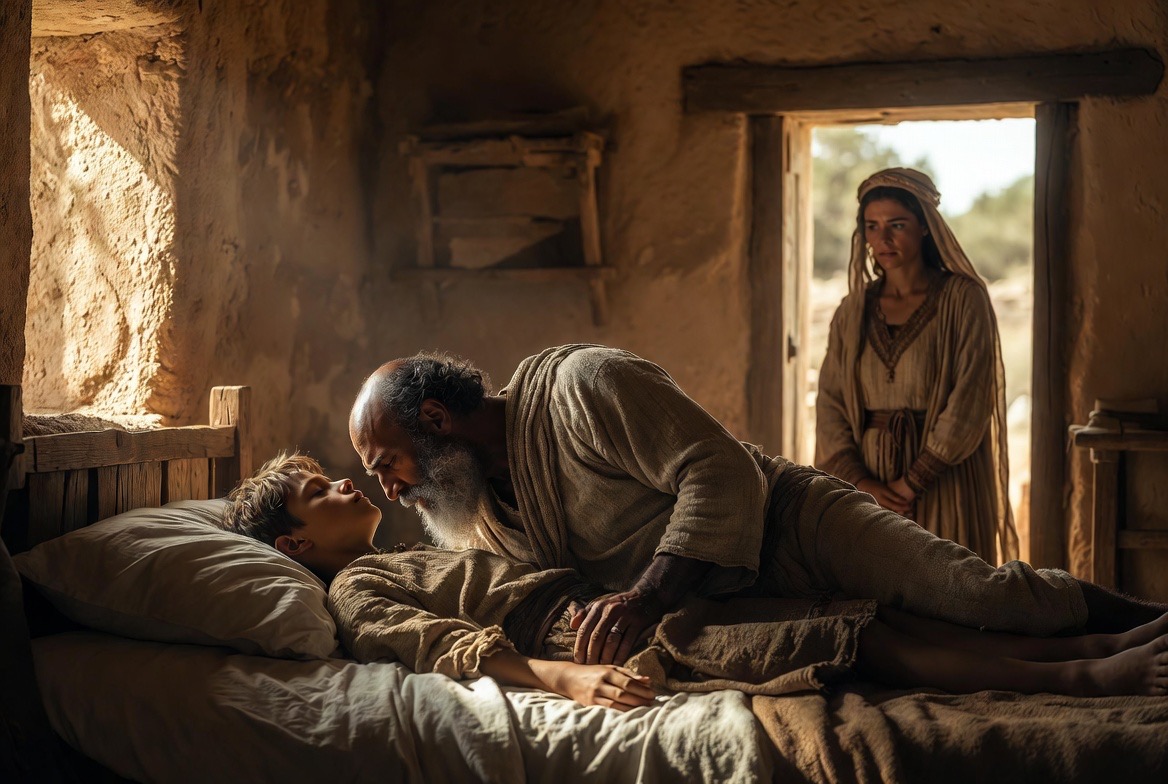
32When Elisha entered the house, behold the boy was dead, laid on his bed. 33So he entered and shut the door behind them both, and he prayed to the LORD. 34Then he got up on the bed and lay on the child, and put his mouth on his mouth, his eyes on his eyes, his hands on his hands, and he bent down on him; and the flesh of the child became warm. 35Then he returned and walked in the house back and forth once, and went up and bent down on him; and the boy sneezed seven times, then the boy opened his eyes. 36And he called Gehazi and said, “Call this Shunammite.” So he called her. And when she came to him, he said, “Pick up your son.” 37Then she came in and fell at his feet and bowed down to the ground, and she picked up her son and left.
NAME SOME WAYS THAT YOU CAN EXPRESS YOUR FAITH IN CHRIST.
BACKGROUND
While this lengthy story features miracles of birth and resurrection, and the role of Elisha as prophet, its real hero is the shunammite woman and her faith. Consider her expressions of faith:
- She believed Elisha was a holy man of God
- She changed her living arrangements to serve the prophet
- She provided for the prophet’s needs when he was in town
- She sought nothing from the prophet but to bless him
- When her son died, she sought Elisha’s help
- She believed Elisha could save her son
- She worshipped when Elisha raised her son from the dead
The Shunammite woman was a woman of faith.
EXAMINATION
(V.8) Now a day came when Elisha went over to Shunem, where there was a prominent woman, and she urged him to eat food. And so it was, as often as he passed by, that he turned in there to eat food.
Shunem was in Israel near Jezreel, the capital of the northern kingdom. The author notes that the Shunammite woman was prominent. She and her husband were likely well-to-do and people of some importance. She prevailed upon Elisha, whenever he was in town, to eat with them.
(V.9-10) And she said to her husband, “Behold now, I am aware that this is a holy man of God passing by us repeatedly. Please, let’s make a little walled upper room, and let’s set up a bed for him there, and a table, a chair, and a lampstand; then it shall be, when he comes to us, that he can turn in there.”
She and her husband are well enough off that they make an addition to their home to accommodate Elisha. Would you add a room to your house for a visitor? This was probably a balcony area that was enclosed and furnished.
WHEN YOU MEET SOMEONE WHO SEEMS VERY SPIRITUAL, WHAT IS YOUR RESPONSE? HOW DO YOU TREAT THAT PERSON?
Notice what the woman tells her husband. “This is a holy man of God.” The Shunammite woman is demonstrating a great respect for spiritual things. She wants to bless the holy man, and as we will see, she expects nothing in return. This happens even today. People often regard pastors, evangelists, and missionaries with a special status of honor. As missionaries, we experience this all the time when visiting supporters. We are often provided with meals, hosted for special events, or offered places to stay, because our hosts want nothing more than to bless us in light of our ministry work. That is likely what is going on here with the Shunammite woman.
(V.13) And he said to him, “Say now to her, ‘Behold, you have taken trouble for us with all this care; what can I do for you? Would you like me to speak for you to the king or to the commander of the army?’” But she answered, “I live among my own people.”
Notice her response to Elisha. “I live among my own people.” In other words, she was content. She sought nothing in return for the kindness she had shown him.
(V.14) So he said, “What then is to be done for her?” And Gehazi answered, “It is a fact that she has no son, and her husband is old.”
In ancient times, to be childless was considered a curse or a tragedy. She may have been content, but she likely longed for a child as any woman in her culture would. Why would Gehazi note that her husband was old? Likely, she never expected to have a child because of her husband’s age. We can probably assume that she was younger; it was not that she was barren.
(V.16-17) Then he said, “At this season next year, you are going to embrace a son.” And she said, “No, my lord, you man of God, do not lie to your servant.” Now the woman conceived and gave birth to a son at that season the next year, as Elisha had told her.
Her response means, please don’t deceive me. Don’t make me promises. She expected nothing. This is reminiscent of Sarah, who laughed at the thought of having a son in her old age. The Shunammite woman did not believe it would happen. Yet, a year later, she had a son.
(V.18-20) When the child was grown, the day came that he went out to his father, to the reapers. And he said to his father, “My head, my head!” And his father said to his servant, “Carry him to his mother.” When he had carried him and brought him to his mother, he sat on her lap until noon, and then he died.
WHAT STICKS OUT TO YOU AS WRONG IN THIS PASSAGE?
This passage has always struck me as a little cold on the father’s part. If faced with a sudden onset of a serious illness, why would you not attend to your child right away? When I got the call at midnight that my daughter had had a stroke, I immediately went to the hospital and didn’t leave her side until she began to recover.
Actually, the text would seem to indicate that the shunammite’s spouse was an inattentive husband. He doesn’t seem to take any interest that a prophet stayed regularly at his house. He seems to have no relationship with him. And when his son is struck ill, he has a servant carry him to the house instead of doing it himself and leaving the servants to attend to the field.
The woman’s response was completely different. She attended to her son until the very end.
(V.22-23) Then she called to her husband and said, “Please send me one of the servants and one of the donkeys, so that I may run to the man of God and return.” But he said, “Why are you going to him today? It is neither new moon nor Sabbath.” So she just said, “It will be fine.”
Notice that the husband doesn’t ask about the welfare of his son. In fact, he doesn’t even put two and two together. My son got struck ill, and now my wife is seeking the prophet. I wonder if these things are related.
When the child died, why do you think the woman went directly to Elisha instead of accepting the situation as hopeless?
But get this, the Shunammite does not tell her husband that their son is dead. Isn’t that odd? If something happened to your child, your spouse would be the first person you would reach out to. But not the shunammite. Perhaps their relationship was not close. Or perhaps she had a plan all along. Perhaps she believed that if she reached Elisha in time, he would rectify the situation. When her husband protests, notice what she says, “It will be fine.” She is hiding what happened from her husband. But though she has terrible grief, she also has great faith; it will be fine.
(V.25) So she went on and came to the man of God at Mount Carmel.
Mount Carmel was about 25 miles from Shunem, roughly a 5-7 hour journey by donkey. Seeing that she didn’t leave until well after noon, she may have returned late at night or early the next morning.
What do we remember Mount Carmel from? It was where Elijah called fire from heaven and slaughtered the prophets of Baal. It was where an altar resided for sacrifice. It was a spiritually significant place.
Notice the text does not say she came to Elisha. It says she came to the man of God. This is a shift in the narrative to note the importance of what she was doing. Elisha was special. He could do what no other man could do. He could give her back her son.
(V.25-26) When the man of God saw her at a distance, he said to Gehazi his servant, “Behold, that person there is the Shunammite. Please run now to meet her and say to her, ‘Is it going well for you? Is it going well for your husband? Is it going well for the child?’” Then she answered, “It is going well.”
The shunammite is not willing to deal with anyone but Elisha. Notice her response to Gehazi. “It is well.” It’s like a distraught person saying, “I’m fine,” when asked what’s wrong.
(V.27-28) But she came to the man of God at the hill and took hold of his feet. And Gehazi came up to push her away, but the man of God said, “Leave her alone, for her soul is troubled within her; and the LORD has concealed it from me and has not informed me.” Then she said, “Did I ask for a son from my lord? Did I not say, ‘Do not give me false hope’?”
Taking hold of his feet shows how distraught she is. She is humbling herself greatly.
“Did I ask for a son?” This was her way of saying her son was dead and her heart was broken. I didn’t ask for this, now look at what has happened. Help me.
(V.32-34) When Elisha entered the house, behold the boy was dead, laid on his bed. So he entered and shut the door behind them both, and he prayed to the LORD. Then he got up on the bed and lay on the child, and put his mouth on his mouth, his eyes on his eyes, his hands on his hands, and he bent down on him; and the flesh of the child became warm.
This is similar to what Elijah did when raising the widow’s son; he lay on top of the boy. But notice how Elisha began. “He prayed to the Lord.” Elijah did the same thing. Addressing the Lord was Elisha’s first act. There would be no miracle without God’s intervention, so Elisha prays for that.
(V.36-37) And he called Gehazi and said, “Call this Shunammite.” So he called her. And when she came to him, he said, “Pick up your son.” Then she came in and fell at his feet and bowed down to the ground, and she picked up her son and left.
The Shunammite’s response to receiving her son back alive was to honor the prophet and worship the Lord. Her faith has won the day.
WHAT HAVE WE LEARNED?
- The Shunammite woman was a person of great faith
- The Shunammite woman honored God by honoring his prophet
- When faced with great tragedy, the Shunammite responded with great faith
- God responded positively to the Shunammite’s expression of faith
INTERPRETATION
What is the author’s big idea?
God rewards the faith of those who trust him.
The Shunammite woman expressed her faith over the course of many years. It was for years that Elisha kept turning to her home. Then there was time to build the addition to her home. Then Elisha continued to visit. She waited a year for a child, then it was several years until her child grew before he died and was raised. In all of that time, she kept faith, even when faced with an inattentive husband and the death of her son. God first rewarded her with a child, and then honored her faith by raising him from the dead.
Another aspect of her faith was her contentment. When asked what Elisha could do for her, her answer was simply, nothing. She was content with the life God had given her, even though she was childless. Her faith in God was enough for her.
What are you content with? Or what are you waiting on God for? Trusting God in faith in our every situation will work itself out to reveal God’s will for our lives.
APPLICATION
True faith in God does not seek personal benefit but seeks to honor and bless.
What is your motivation for following Christ? Many people seek God transactionally rather than relationally. They follow their faith for what they can get out of it. This is especially true in the modern world. We look for and expect blessings. Why would we follow a god who allows pain or need or suffering? Yet, the Bible is clear that God sometimes brings these things on people to grow them spiritually and grow their faith. A person who only follows Christ transactionally, for what he can get out of it, easily falls away when things get rough. Determine to pursue God for the relationship rather than for benefits. Benefits will come, but they should not be our focus.
When faced with a great trial, our first response should be to trust God in faith.
Remember when the son of the widow at Zarephath died in I Kings 17. She blamed Elijah for what took place. She said, “You have come to me to bring my wrongdoing to remembrance, and to put my son to death!” But the Shunammite’s response stands in contrast to the widow’s. Her first response was to seek out Elisha for a solution. Hers was an expression of faith.
Faith is a practical expression of trust in God. When trouble comes, our first response should be to seek God for what he plans to do with our situation. Before every trial or major decision, we should express our faith by seeking God’s will or plan. And we should trust him no matter what. Remember Job’s words when faced with great suffering. “Though he slay me, yet I will hope in him” (Job 13:15). Maintain your faith in Christ, no matter what.
When God answers our faith, our response should be to worship and honor God.
Thankfulness is expressed in worship. Do you want to rejoice in faith, no matter what befalls you? Then respond to God in worship, thanking him for what he has done. Remember, your attitude of gratitude determines your altitude.
Sometimes, an attitude of worship is all we need to reset our hearts toward trust and faith.