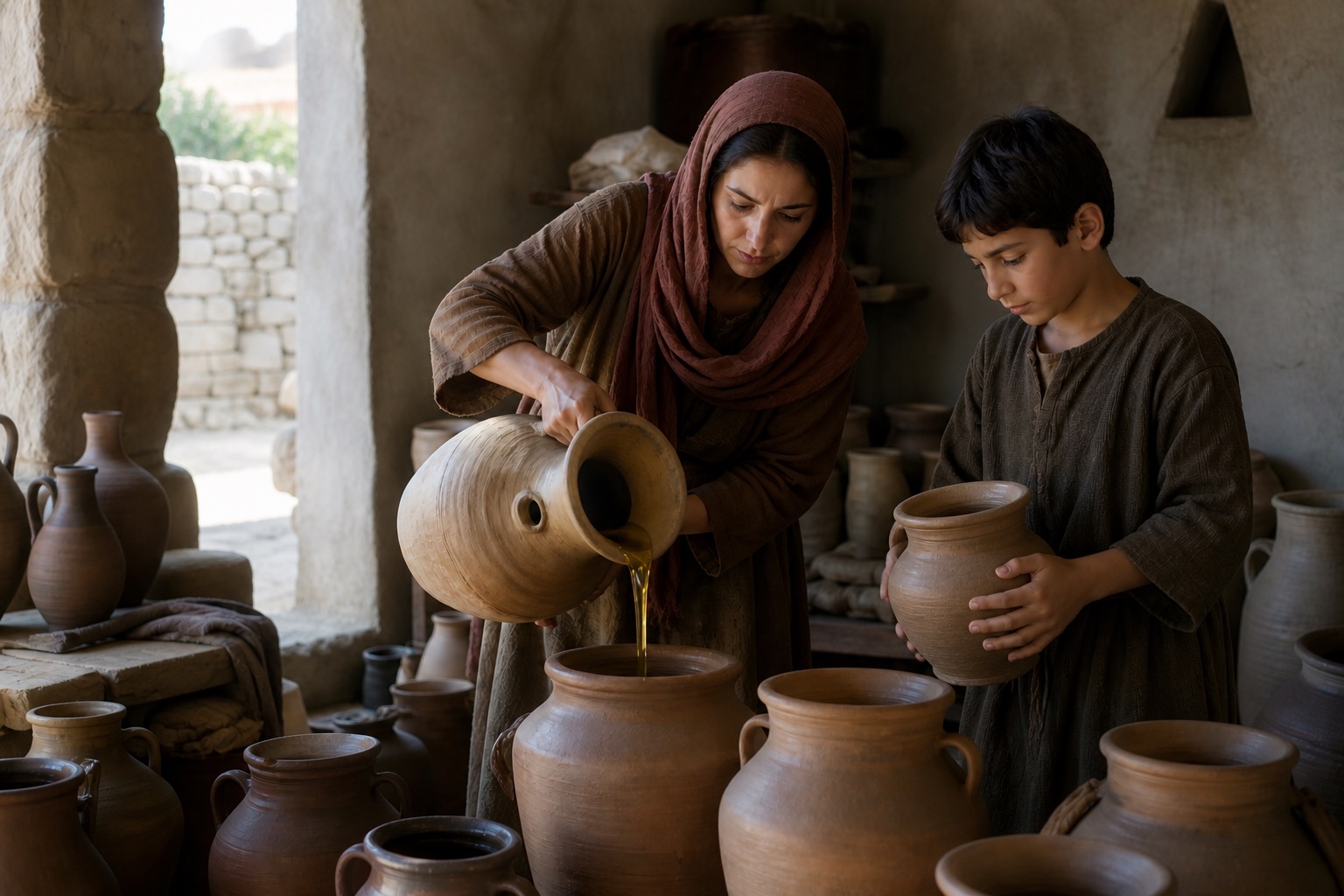
II Kings 4:1-7
WHAT PLACE DOES MEETING THE NEEDS OF THE LESS FORTUNATE HAVE IN YOUR LIFE?
Now a woman of the wives of the sons of the prophets cried out to Elisha, saying, “Your servant my husband is dead, and you know that your servant feared the LORD; and the creditor has come to take my two children to be his slaves.” 2So Elisha said to her, “What shall I do for you? Tell me, what do you have in the house?” And she said, “Your servant has nothing in the house except a jar of oil.” 3Then he said, “Go, borrow containers elsewhere for yourself, empty containers from all your neighbors—do not get too few. 4Then you shall come in and shut the door behind you and your sons, and pour into all these containers; and you shall set aside what is full.” 5So she left him and shut the door behind her and her sons; they began bringing the containers to her, and she poured the oil. 6When the containers were full, she said to her son, “Bring me another container.” But he said to her, “There are no more containers.” Then the oil stopped. 7So she came and told the man of God. And he said, “Go, sell the oil and pay your debt, and you and your sons can live on the rest.”
BACKGROUND
There are three things we should touch on in the way of background in this passage: slavery, widows, and oil.
The kind of slavery being referred to in our passage today is not general slavery like we have seen throughout history. Slavery in Old Testament times in Israel was usually a matter of paying off a debt. At that time, people would guarantee a loan based upon their own persons, not upon their personal property. In other words, you yourself were the collateral. A person could sell themselves into slavery to pay off a debt. This might seem cruel to us, but slavery in the Old Testament was a temporary condition. That is, a person could be sold into slavery to pay off the debt until the year of Jubilee, which took place once every seven years, then they would have to be set free. “If you buy a Hebrew slave, he shall serve for six years; but on the seventh he shall go out as a free man without payment” (Exodus 21:2). The rules regarding slavery and the year of jubilee were very clear. “Now if a countryman of yours becomes so poor with regard to you that he sells himself to you, you shall not subject him to a slave’s service. He shall be with you as a hired worker, as if he were a foreign resident; he shall serve with you up to the year of jubilee. He shall then leave you, he and his sons with him, and shall go back to his family, so that he may return to the property of his forefathers” (Leviticus 25:39-41).
Therefore, it was within the creditor‘s rights to demand the slavery of the widow’s sons to pay off the debt of her dead husband. It may seem cruel, and in one sense it is cruel, but it was how the legal system was set up to deal with debt and slavery. God never intended slavery to be a permanent institution. Slavery was set up to be a system of financial relief.
We should also mention that this text deals with a widow. God keeps widows in a special place in his heart in the Old Testament law. People were to care for widows and orphans, and it was a sign that they were truly righteous if they did so. “You shall not afflict any widow or orphan. If you afflict him at all, and if he does cry out to Me, I will surely hear his cry” (Exodus 22:22-23). In the New Testament, James repeats this status. “Pure and undefiled religion in the sight of our God and Father is this: to visit orphans and widows in their distress” (James 1:27). How we treat others less fortunate than ourselves is important to God. When we were helpless, at the right time, Jesus died for us. How much more should we care for those less fortunate than ourselves?
Most oil in ancient times was olive oil, used for cooking, anointing, or washing. It was also used as fuel for lamps. Oil, therefore, was a basic commodity needed by all households. Without it, you could not cook, wash, light your home, or perform some religious rituals. Everyone needed oil. So, this miracle was virtually guaranteed to provide what the widow needed, as there was always a market for oil.
THESE THREE THINGS, SLAVERY, ORPHANS, AND OIL, REPRESENT MONEY, RELATIONSHIPS, AND BASIC COMMODITIES. HOW CAN WE PROVIDE THESE BASIC THINGS FOR THE LESS FORTUNATE?
EXAMINATION
(V.1) Now a woman of the wives of the sons of the prophets cried out to Elisha, saying, “Your servant my husband is dead, and you know that your servant feared the LORD; and the creditor has come to take my two children to be his slaves.”
We have something to learn here about the community or school of the prophets that existed during that time. Usually, when we think of institutions like this, we think of something like people living as monks in solitude somewhere. But this was not the case with the community of prophets in Israel. They led fairly normal lives, had families, as well as performing their ministry. And that is what we see here. They were also subject to the same problems that we have; in this case, it was massive debt. The debt was so bad that this woman was going to have to sell her sons into slavery to pay her debt. So these prophets faced the same common problems as anyone else, on top of their regular ministries.
Even people who work in ministry are subject to the same types of problems that everyone else faces. But ministry doesn’t often pay well. Or pay enough to take care of all issues. That happens sometimes. As it happened with this man and his family and his ministry. In fact, in this situation, the prophet in question probably did not have much of an income because there was not a large believing community to support the prophets. Remember that Israel was in rebellion against God during this time. So the prophets probably subsisted on very little. But God is about to give this woman a solution.
(V.2) So Elisha said to her, “What shall I do for you? Tell me, what do you have in the house?” And she said, “Your servant has nothing in the house except a jar of oil.”
ELISHA ASKED, “WHAT DO YOU HAVE IN THE HOUSE?” WHAT DO YOU HAVE THAT CAN BE USED BY GOD TO TURN INTO A RESOURCE TO MEET YOUR NEEDS, OR OTHER’S NEEDS?
Ministry is not something to get rich off of, though some people do. It certainly was not the case with this family. Though this man was a prophet, he was poor and had little to care for his family. Signified by the fact that the woman had literally nothing left, except for a single jar of oil. Elisha asked her what she had because he was probably thinking she could sell some of what she had to make some money to care for her sons. But that would only be a temporary solution. Instead, she told him what she had, which was a single jar of oil.
(V.3-4) Then he said, “Go, borrow containers elsewhere for yourself, empty containers from all your neighbors—do not get too few. Then you shall come in and shut the door behind you and your sons, and pour into all these containers; and you shall set aside what is full.”
One thing this passage shows us is God‘s care for the individual, especially the less fortunate. This was not a prayer for wealth or convenience.
When I worked for a small Christian radio station in Tucson, Arizona, we hired an engineer to install a satellite dish for our news programming. The engineer was not a believer, and I thought this might be a good witness. As he tuned in the audio frequency, he scanned the video channels as well. That’s when something happened that ruined our witness. The audio was tuned into a Christian talk show called Darin’s Coffee Shop. A woman was on the phone complaining that she needed God to give her a dishwasher because she had kids, and was busy, and couldn’t take time to wash the dishes, and please God give me a dishwasher. However, the video channel was tuned to news programming with scenes of war, destruction, suffering, and emaciated children. As we watched the video and heard Darin believing God for a dishwasher, the look on the engineer’s face said, “Really? Is this your Christianity?” All chance for a positive witness was lost.
God was supplying the widow’s basic needs to keep her from starving or losing her children. This is what God cares about.
WHY DON’T WE LIKE DEPENDING UPON OTHERS FOR OUR NEEDS?
Part of Elisha‘s solution for this woman’s problems was to depend upon the generosity of others. She was to borrow containers from other families temporarily. Sometimes we need the help of others. Sometimes we are too prideful to ask for help because we, especially in America, like to pull ourselves up by our own bootstraps. We like to be self-sufficient. But sometimes God‘s plan for us is to depend upon others to care for our needs. As we will see here, God was going to use what was borrowed to provide for this woman’s needs in a great way.
(V.5-6) So she left him and shut the door behind her and her sons; they began bringing the containers to her, and she poured the oil. When the containers were full, she said to her son, “Bring me another container.” But he said to her, “There are no more containers.” Then the oil stopped.
This miracle was to benefit the widow and her sons. This is often the case with Elisha’s miracles; they benefited individuals or families. They were not miracles for an entire nation. This is very much like Christ, who did miracles to benefit individuals: healing blindness, deafness, the lame, and so on. These were miracles that benefited individuals that showed God‘s love for individuals. The same was true with most of Elisha’s miracles as well.
(V.7) So she came and told the man of God. And he said, “Go, sell the oil and pay your debt, and you and your sons can live on the rest.”
Sometimes God’s provision means that we must take part in the solution. God didn’t just provide money for the widow to pay off her debts. He provided her with a resource that she had to take responsibility for, to go and sell. She had a role to fulfill in paying off her own debts.
This is the first time that Elisha is referred to as a man of God. The last time we see this phrase used was of Elijah when the widow with whom he was living referred to him as a man of God regarding her son, whom he raised from the dead. In fact, there are other similarities between this miracle and the woman and Elijah. In Elijah’s case, he had provided the miracle of the perpetual oil and flour to meet their family’s needs. In comparison with this miracle, both were miracles in which oil was involved. Both were needed to take care of extreme poverty. Both miracles provided for their benefactors for a long period of time.
We should mention here that in the Scriptures, oil is a picture or type for the Holy Spirit. Just as this widow was provided enough oil to live on, so too, the Holy Spirit is provided for you and I, enough to live on. That is, to live the Christian life with all of the power and resources that we need to live for Christ. This widow provided her oil to others that she might live, so too we are to provide blessings that we might live for Christ as well. God never fills us with the Holy Spirit just to have a religious experience or to bless us. But the filling of the Spirit and the gifts of the Spirit are always to be used to serve the body of Christ and those around us.
WHAT HAVE WE LEARNED?
- God cares deeply about the less fortunate.
- God desires to meet the needs of the less fortunate and destitute through his people.
- We are the conduit through which God blesses, as Elisha was.
- God’s provision is more than enough for our needs, so we may meet the needs of others.
INTERPRETATION
What is the author’s big idea?
God cares about the less fortunate and desires to use us to meet their needs.
The scripture is filled with this theme. How we meet the needs of the less fortunate is something God will judge us by. There are always needs around us. Jesus said, “You will always have the poor” (Matthew 26:11). Paul tells us that the less fortunate have been prepared by God so that we might do good to them. “For we are His workmanship, created in Christ Jesus for good works, which God prepared beforehand so that we would walk in them” (Ephesians 2:10). Caring for the less fortunate was a key theme in Paul’s ministry. He discussed this in Galatians 2:10. “They only asked us to remember the poor—the very thing I also was eager to do.”
The Old Testament Law featured caring for the poor as central to its requirements. The edges of fields were not to be gleaned, but left for the poor (Deuteronomy 24:19).
Consider these passages about the less fortunate:
- “You shall not oppress any widow or orphan” (Exodus 22:22).
- “Let your widows trust in me” (Jeremiah 49:11).
- “Then I will come near to you for judgment; and I will be a swift witness against…those who oppress the wage earner in his wages or the widow or the orphan, and those who turn away the stranger from justice” (Malachi 3:5).
- “He executes justice for the orphan and the widow, and shows His love for the stranger by giving him food and clothing” (Deuteronomy 10:18).
- “Learn to do good; seek justice, rebuke the oppressor, obtain justice for the orphan, plead for the widow’s case” (Isaiah 1:17).
APPLICATION
This short account, involving the prophet Elisha, carries several tightly connected truths:
1. God sees and cares about personal need.
A widow is facing the loss of her sons due to debt. This is not a national crisis—it’s a private, painful situation. Yet God intervenes. God’s concern is not limited to big, public events. He cares about individual struggles.
2. God often starts with what you already have.
Elisha asks, “What do you have in your house?” Her answer: just a small jar of oil. God frequently uses what seems insignificant as the starting point for His provision.
3. Obedience unlocks provision.
The widow is told to gather empty jars and pour. There’s no visible miracle at first—just a command that requires faith. The miracle happens as she obeys, not before.
4. God’s provision is as large as the capacity of faith.
The oil only stops when there are no more jars. The limitation wasn’t God’s supply—it was the number of vessels brought. The more you bring to God of needs to be met, the more we can trust him with.
5. God’s provision is sufficient and complete.
She sells the oil, pays her debts, and lives on the rest. God doesn’t just barely meet needs—He provides fully and sustainably.
6. Make the less fortunate part of your life and plans.
How do you budget your time, finances, or resources for the less fortunate? Intentionally look for opportunities to help those with great needs.
7. Pray for opportunities to be compassionate.
This is a prayer God will always say yes to. Having compassion means extending mercy to the guilty or less fortunate, forgiving those who sin against you, and sharing your resources with those in need.