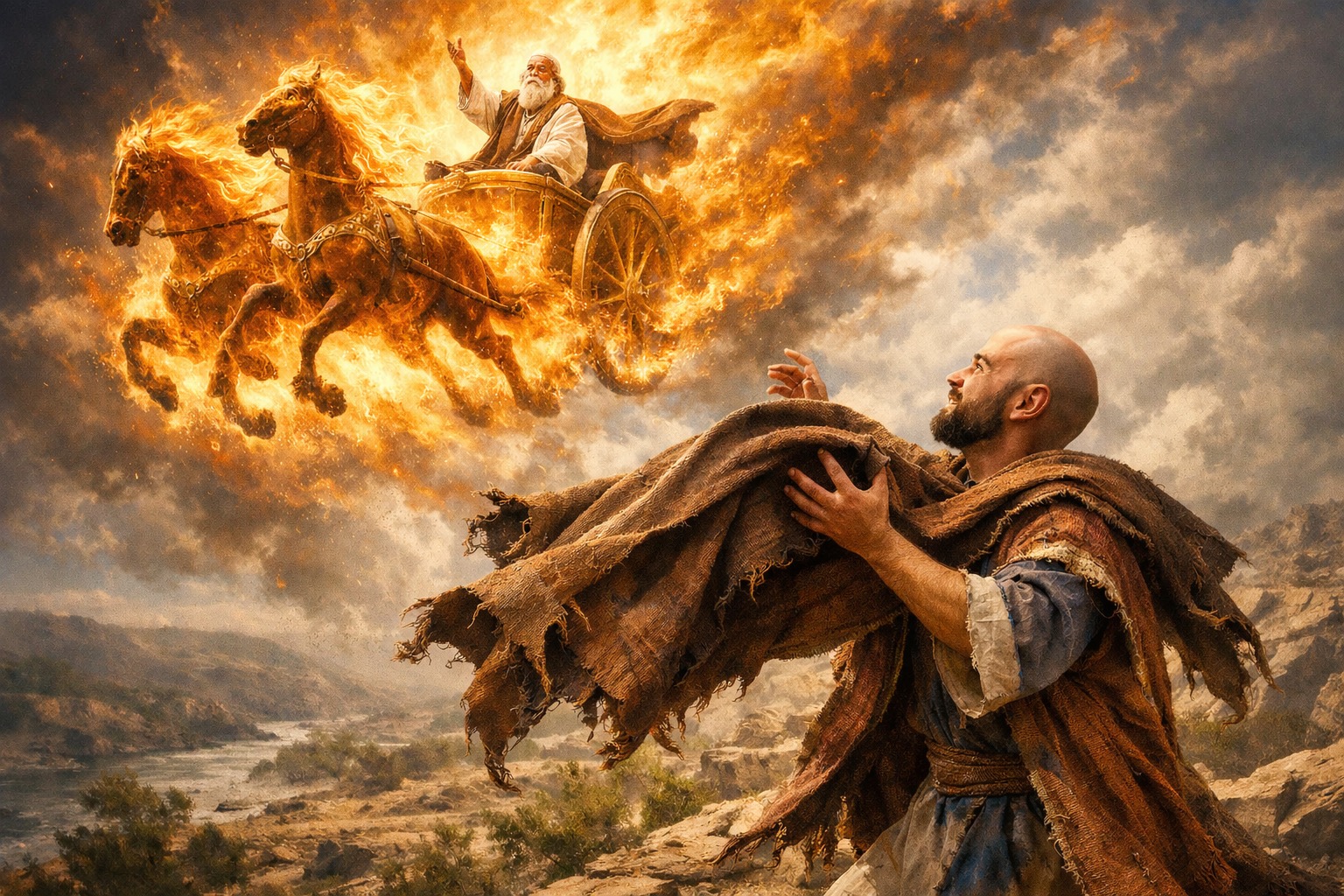
II Kings 2:1-14
1Now it came about, when the LORD was about to bring Elijah up by a whirlwind to heaven, that Elijah left Gilgal with Elisha. 2And Elijah said to Elisha, “Stay here, please, for the LORD has sent me as far as Bethel.” But Elisha said, “As surely as the LORD lives and as you yourself live, I will not leave you.” So they went down to Bethel. 3Then the sons of the prophets who were at Bethel went out to Elisha and said to him, “Are you aware that the LORD will take away your master from over you today?” And he said, “Yes, I am aware; say nothing about it.”
4And Elijah said to him, “Elisha, please stay here, for the LORD has sent me to Jericho.” But he said, “As surely as the LORD lives, and as you yourself live, I will not leave you.” So they came to Jericho. 5Then the sons of the prophets who were at Jericho approached Elisha and said to him, “Do you know that the LORD will take away your master from over you today?” And he answered, “Yes, I know; say nothing about it.” 6And Elijah said to him, “Please stay here, for the LORD has sent me to the Jordan.” But he said, “As surely as the LORD lives, and as you yourself live, I will not leave you.” So the two of them went on.
7Now fifty men of the sons of the prophets went and stood opposite them at a distance, while the two of them stood by the Jordan. 8And Elijah took his coat, folded it, and struck the waters, and they were divided here and there, so that the two of them crossed over on dry ground.
9When they had crossed over, Elijah said to Elisha, “Ask me what I should do for you before I am taken from you.” And Elisha said, “Please let a double portion of your spirit be upon me.” 10He said, “You have asked a hard thing. Nevertheless, if you see me when I am taken from you, it shall be so for you; but if not, it shall not be so.” 11And as they were walking along and talking, behold, a chariot of fire appeared with horses of fire, and they separated the two of them. Then Elijah went up by a whirlwind to heaven. 12And Elisha was watching it and he was crying out, “My father, my father, the chariot of Israel and its horsemen!” And he did not see Elijah again. Then he took hold of his own clothes and tore them in two pieces. 13He also took up the coat of Elijah that had fallen from him, and he went back and stood by the bank of the Jordan. 14Then he took the coat of Elijah that had fallen from him and struck the waters, and said, “Where is the LORD, the God of Elijah?” And when he also had struck the waters, they were divided here and there; and Elisha crossed over.
BACKGROUND
At this point in our study, Elisha has likely been with Elijah for seven or eight years as his attendant. We do not know what kinds of things Elisha has seen with his mentor, as we are not told in scripture. But he likely was present when Elijah rebuked Ahab for the death and treachery concerning Naboth and his vineyard in I Kings 21. He may have been present when Elijah called fire from heaven on the two captains and their fifties. But we do not know for sure.
When Elijah met Elisha, he threw his coat over him, indicating he was calling him to be a prophet in his place. At this point in the story, Elisha has waited several years to see that promise fulfilled. Yet, what we see in this story is not a man rushing to gain power, but a man focused on following his mentor with faithfulness and loyalty, refusing to leave him no matter where he may go.
If there’s anything to note about Elisha’s portion in this story, it is his undying loyalty to Elijah. When the two men first met, Elisha was ecstatic about joining Elijah‘s ministry and serving him. He likely continued that attitude for the whole seven to eight years that they were together before Elijah went to heaven. In this story, just before Elijah transitions to Heaven, Elisha remains with his mentor all throughout his journeys, no matter where he goes. That’s loyalty.
There are three transitions in the Bible from one prophet of God to a new one: Moses to Joshua, Elijah to Elisha, and John the Baptist to Jesus. Joshua means God saves. Elisha means God is salvation. Jesus means God saves. In each instance, God was transitioning these leaders to people who would have saving ministries. In light of this, we should see Elisha’s ministry as a type for the ministry of Jesus.
“There is a theological significance to the parallels between Elijah and Moses. Moses was the mediator of the covenant at Sinai/Horeb, the prophet (Dt. 18:15; 34:10) through whom Israel was brought into that covenant relationship and made the people of God. Elijah was the prophet through whom the people were turned back to the Sinai covenant, and Israel’s special status was saved. In short, the parallels with Moses dramatically heighten Elijah’s importance in Israel’s history and in the books of Kings in particular. H. H. Rowley (‘Elijah on Mount Carmel’, BJRL, 43 [1960], 190–219) neatly summed up the relationship between the ministries of Moses and Elijah: ‘Without Moses, the religion of Yahweh as it figured in the Old Testament would never have been born. Without Elijah, it would have died.’” (1)
EXAMINATION
(V.1-2) Now it came about, when the LORD was about to bring Elijah up by a whirlwind to heaven, that Elijah left Gilgal with Elisha. And Elijah said to Elisha, “Stay here, please, for the LORD has sent me as far as Bethel.” But Elisha said, “As surely as the LORD lives and as you yourself live, I will not leave you.” So they went down to Bethel.
What does Elijah’s repeated instruction for Elisha to “stay here” reveal about testing, commitment, or readiness in spiritual leadership?
Elijah knew he was to be taken to heaven this day, but notice what he does; he continues to travel to see the schools of the prophets, to visit them. He is carrying out his normal duties as prophet. He may have been the one to inform the lesser prophets of his departure, but we don’t really know that for sure.
Here also is our first indication of Elisha’s faithfulness to his mentor. He will not leave his side. Elijah asked Elisha to stay there, but it was a request, not a command. He is likely testing Elisha to see what he will do.
(V.3) Then the sons of the prophets who were at Bethel went out to Elisha and said to him, “Are you aware that the LORD will take away your master from over you today?” And he said, “Yes, I am aware; say nothing about it.”
Elisha responds, “Yes, I know—be quiet.” Why might Elisha want to keep the focus off discussion and on the moment?
Here is our first indication that Elijah and Elisha knew in advance what was going to happen to Elijah. Not only did they know, but the other prophets also knew.
Elisha responds to the prophets by saying, “I am aware; say nothing about it.” This is like asking, do you know your mentor is going to die today? Elijah is essentially saying, don’t add to my sorrow. I know what’s going to happen.
(V.4-5) And Elijah said to him, “Elisha, please stay here, for the LORD has sent me to Jericho.” But he said, “As surely as the LORD lives, and as you yourself live, I will not leave you.” So they came to Jericho. Then the sons of the prophets who were at Jericho approached Elisha and said to him, “Do you know that the LORD will take away your master from over you today?” And he answered, “Yes, I know; say nothing about it.”
Here, Elijah’s urging him to stay happens a second time, yet Elisha refused to leave him. This school of prophets also knows about Elijah’s imminent departure. Elisha’s loyalty here was likely his M.O. during his entire ministry as the elder prophet’s attendant. For Elisha, going into ministry with Elijah was like a dream come true. Remember his reaction when Elijah called him into ministry. He said goodbye to his parents, killed his oxen to feed a community, and burned the implements of his livelihood. He was excited to join Elijah. It’s remarkable that eight years later, he keeps that attitude, now expressed in great loyalty.
(V.6) And Elijah said to him, “Please stay here, for the LORD has sent me to the Jordan.” But he said, “As surely as the LORD lives, and as you yourself live, I will not leave you.” So the two of them went on.
“The trip from Gilgal to Bethel to Jericho to the Jordan retraces the first movements Israel made in the promised land.” (2)
“Gilgal was the first stopping-place after the Israelites had crossed the Jordan. Male Israelites born during the wilderness years were circumcised there, and a Passover was celebrated. Bethel, some 14 miles (24 km) into the central hills, was the place of Jacob’s encounter with God. Jericho, in the Jordan valley not far from Gilgal, was the first town to fall to Joshua, and the Jordan had miraculously stopped to let Israel enter the land. (3)
“Most scholars believe the point of his not leaving Elijah’s side is to test whether Elisha will count the cost of discipleship, probably a final test to see if he will persist. We see something of our own call here—to forsake all for the glory of the Name. The question for us, like Elisha, is, will we persist and persevere? This is the sign of the true disciple: we bring the Word near, and we delight in God above all else.” (4)
(V.7-8) Now fifty men of the sons of the prophets went and stood opposite them at a distance, while the two of them stood by the Jordan. And Elijah took his coat, folded it, and struck the waters, and they were divided here and there, so that the two of them crossed over on dry ground.
The parting of the Jordan River happens twice—first with Elijah, then with Elisha. Why is this miracle significant for confirming God’s presence and leadership?
This is reminiscent of Moses dividing the waters. In Moses’ case, he had a staff that was symbolic of his authority and power. Elijah’s symbol of authority and power was his coat (mantle).
The presence of the fifty prophets is an important one. They were witnesses to Elijah parting the waters of the Jordan. Thus, when Elisha returned, they witnessed him parting the waters. Essentially, they were witnesses to the handover of authority from one prophet to another.
(V.9-10) When they had crossed over, Elijah said to Elisha, “Ask me what I should do for you before I am taken from you.” And Elisha said, “Please let a double portion of your spirit be upon me.” He said, “You have asked a hard thing. Nevertheless, if you see me when I am taken from you, it shall be so for you; but if not, it shall not be so.”
Elijah responds, “You have asked a hard thing.” Why is receiving spiritual authority or empowerment described as difficult? What does this suggest about the cost and responsibility of leadership in God’s work?
It was common in ancient times for a dying person to offer blessings to others or their children. Jacob blessed his sons at his death, prophesying over them. David gave instructions and blessings to Solomon before he died. Elijah is doing something similar in this passage. He seeks to bless his faithful student before he is taken away from him.
Remember our lesson about Elijah and Elisha meeting. We made reference to Elijah’s coat being a way of granting sonship to the younger Elisha. That is intimated in this passage was well. By asking for a double portion, Elisha is asking for the traditional blessing of a father giving a double portion of his inheritance to his eldest son. In this sense, the request is not unusual, but something almost expected if they had a relationship like a father and an adopted son. And this plays out in the next verse.
(V.11-12) And as they were walking along and talking, behold, a chariot of fire appeared with horses of fire, and they separated the two of them. Then Elijah went up by a whirlwind to heaven. And Elisha was watching it, and he was crying out, “My father, my father, the chariot of Israel and its horsemen!” And he did not see Elijah again.
Notice, Elisha cries out, “My father, my father!” This is the role of a firstborn son; thus, he receives the double portion promised to him.
There are two things to note here: the chariots of fire and the storm. Both are symbolic in Elijah’s ministry. Just as Elijah thrice called fire from heaven, now a fire takes him to heaven. Just as a storm restored rain to Israel, now a whirlwind, or storm, marks his departure. Elijah’s ministry was filled with symbolism, as was his departure from the earth to heaven.
(V.13-14) He also took up the coat of Elijah that had fallen from him, and he went back and stood by the bank of the Jordan. Then he took the coat of Elijah that had fallen from him and struck the waters, and said, “Where is the LORD, the God of Elijah?” And when he also had struck the waters, they were divided here and there; and Elisha crossed over.
After Elijah is taken, Elisha picks up the mantle and continues the work. What does the mantle symbolize in terms of responsibility and calling?
By taking up Elijah’s coat, Elisha is taking up Elijah’s authority. The office of prophet has now passed to him, but in an even greater way. Remember that when Elijah and Elisha met, Elijah threw his coat over Elisha, signifying that he was to become prophet in his place. So, from day one, Elisha knew that this was coming.
WHAT HAVE WE LEARNED?
- Elisha had a strong sense of affection and loyalty for his mentor.
- Elijah, Elisha, and the prophets knew Elijah was to be taken to heaven.
- Elijah sought to give a blessing to Elisha.
- Elisha received a double portion of Elijah’s power for ministry when Elijah left.
- Fifty prophets were witness to the change in ministry and authority from Elijah to Elisha.
INTERPRETATION
What is the author’s big idea? There are two points for us to consider.
God rewards faithfulness and loyalty. Elisha was faithful in attending to Elijah, whether for several years as his attendant, or in going with him in his final days on earth before being taken to heaven. Notice what Elisha asked to have. He asked for a double portion of his power for ministry. I don’t think he was asking for power for power’s sake. He was asking for an effective ministry. This became true in Elisha’s life. In scripture, seven miracles are associated with Elijah, but twice that amount, 14, with Elisha. While Elijah’s miracles were usually judgment in nature, such as calling fire from heaven, Elisha’s miracles were saving in nature. God rewarded his faithfulness and loyalty to Elijah.
Discipleship requires commitment. Elisha would not leave Elijah’s side, no matter where it took him. Each time Elijah encouraged Elisha to stay where he was, he was testing him to see what he would do. But Elisha stays with him no matter what, even though he knew Elijah would be taken from him. He was like a dutiful son that will not leave his father’s side.
APPLICATION
Stay Faithful When Transition Is Coming
Elijah knew his departure was near, yet he continued traveling, visiting key places, and investing in others. Elisha refused to leave him.
Application: When seasons are changing—career shifts, ministry transitions, leadership handoffs—don’t disengage early. Finish well. Stay present, committed, and faithful until the very end.
Pursue Spiritual Growth with Determination
Elisha repeatedly said, “I will not leave you.” He was intentional about staying close to Elijah.
Application: Spiritual growth doesn’t happen casually. Seek out mentors. Stay close to godly influence. Be persistent in learning. Growth requires intentional pursuit, not passive interest.
Ask God for Big Things
Elisha asked for a “double portion” of Elijah’s spirit—a bold, faith-filled request.
Application: Don’t limit your prayers to what seems safe or reasonable. Ask God to use you in greater ways—for influence, impact, and spiritual power—while remaining humble and dependent on Him.
Recognize That God Is the Source, Not the Person
After Elijah was taken up, Elisha picked up the cloak and called on the God of Elijah.
Application: People may mentor, inspire, and lead us, but they are not the source of power—God is. When leaders move on, retire, or pass away, the mission continues because God remains.
Step Forward in Faith When It’s Your Turn
Elisha struck the Jordan River just as Elijah did—and it parted. This was his moment to act.
Application: There comes a time when you must step forward and lead, not just follow. Trust what God has already given you. Act in faith, even if it feels weighty. Walk in the calling you’ve received.
- Bimson, John J. 1994. “1 and 2 Kings.” In New Bible Commentary: 21st Century Edition, edited by D. A. Carson, R. T. France, J. A. Motyer, and G. J. Wenham, 4th ed., 363–64. Leicester, England; Downers Grove, IL: Inter-Varsity Press.
- House, Paul R. 1995. 1, 2 Kings. Vol. 8. The New American Commentary. Nashville: Broadman & Holman Publishers.
- Bimson, John J. 1994. “1 and 2 Kings.” In New Bible Commentary: 21st Century Edition, edited by D. A. Carson, R. T. France, J. A. Motyer, and G. J. Wenham, 4th ed., 363. Leicester, England; Downers Grove, IL: Inter-Varsity Press.
- Merida, Tony. 2015. Exalting Jesus in 1 & 2 Kings. Nashville, TN: Holman Reference.