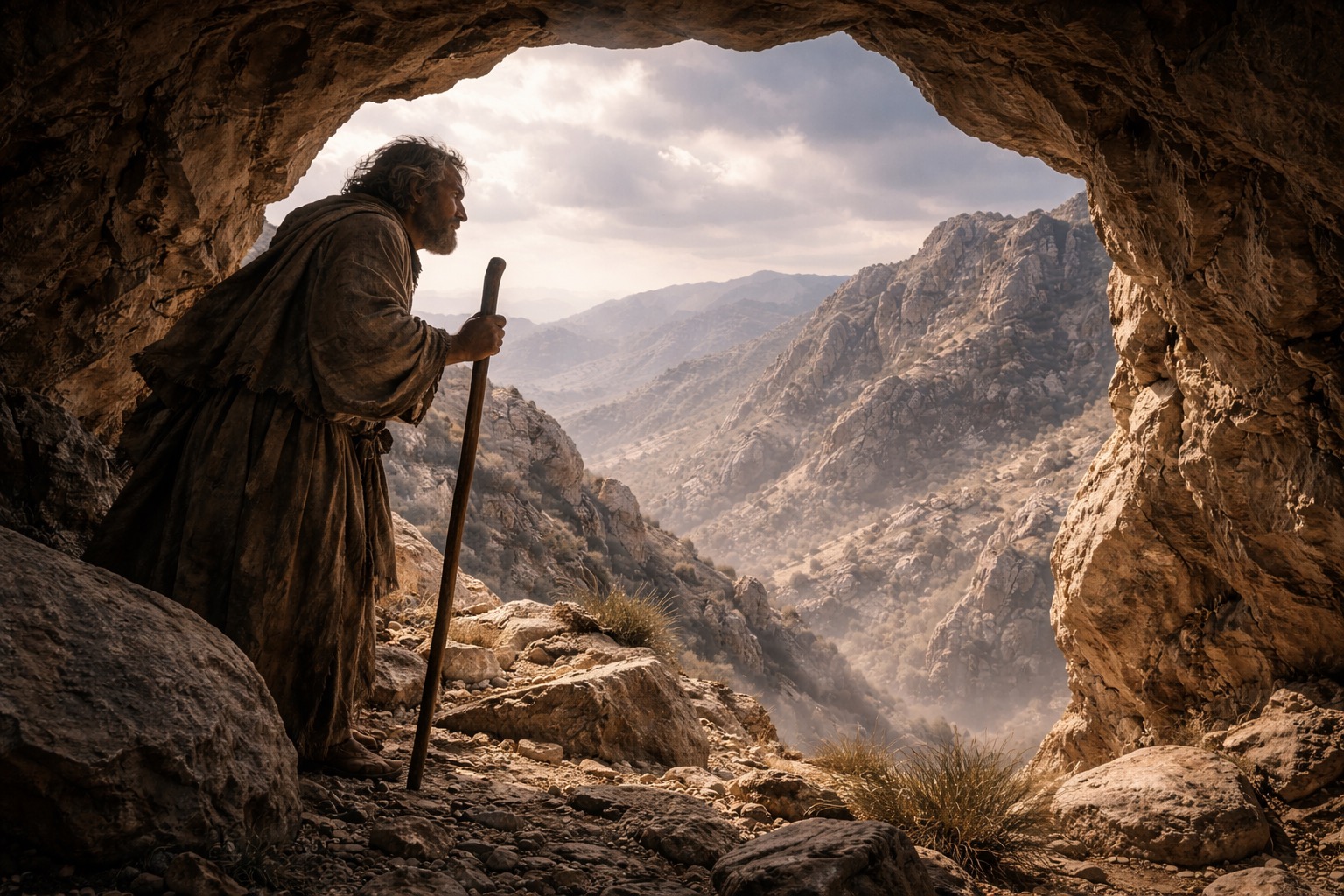
I Kings 19:9-18
Then he came there to a cave and spent the night there; and behold, the word of the LORD came to him, and He said to him, “What are you doing here, Elijah?” And he said, “I have been very zealous for the LORD, the God of armies; for the sons of Israel have abandoned Your covenant, torn down Your altars, and killed Your prophets with the sword. And I alone am left; and they have sought to take my life.”
So He said, “Go out and stand on the mountain before the LORD.” And behold, the LORD was passing by! And a great and powerful wind was tearing out the mountains and breaking the rocks in pieces before the LORD; but the LORD was not in the wind. And after the wind there was an earthquake, but the LORD was not in the earthquake. And after the earthquake, a fire, but the LORD was not in the fire; and after the fire, a sound of a gentle blowing. When Elijah heard it, he wrapped his face in his cloak and went out and stood in the entrance of the cave. And behold, a voice came to him and said, “What are you doing here, Elijah?” Then he said, “I have been very zealous for the LORD, the God of armies; for the sons of Israel have abandoned Your covenant, torn down Your altars, and killed Your prophets with the sword. And I alone am left; and they have sought to take my life.”
The LORD said to him, “Go, return on your way to the wilderness of Damascus; and when you have arrived, you shall anoint Hazael king over Aram. You shall also anoint Jehu the son of Nimshi king over Israel; and you shall anoint Elisha the son of Shaphat of Abel-meholah as prophet in your place. And it shall come about that the one who escapes from the sword of Hazael, Jehu shall put to death, and the one who escapes from the sword of Jehu, Elisha shall put to death. Yet I will leave seven thousand in Israel, all the knees that have not bowed to Baal and every mouth that has not kissed him.”
IN THIS PASSAGE, GOD SPEAKS TO ELIJAH IN A GENTLE BLOWING. HOW HAS GOD MOVED, INSPIRED, OR SPOKEN TO YOU?
BACKGROUND
We noted in our last study that Elijah was suffering from serious depression. He had fled for his life and asked to die. Not a combination that makes sense. But that’s part of what depression does. It confuses our thinking.
As we approach this passage, Elijah’s depression is still there. He repeats his complaint to God twice. He seems to have little hope. As we will see, God will give him two things that will help Elijah to overcome his depression.
This passage shows God reassuring Elijah that despite apparent spiritual defeat, God remains committed to his covenant promises and will continue directing Israel’s history according to his word. (1) The central comfort offered is God’s reliable word, which never fails. (2)
The passage unfolds through a dramatic encounter. Elijah arrives at Horeb despairing that he alone remains faithful while Israel has abandoned God’s covenant and killed his prophets. He had expected the Mount Carmel victory to produce lasting religious reform. (2) But this was not to be. Rather than meeting God in spectacular displays—wind, earthquake, or fire—God appears in “a sound of a gentle blowing.” This shift emphasizes that God communicates through his word, not through power alone.
God then commissions Elijah to anoint three successors—Hazael as king of Aram, Jehu as king of Israel, and Elisha as prophet—and reveals that through these leaders, judgment will come upon the unfaithful. Yet God assures Elijah that 7,000 Israelites remain faithful to the covenant. Elijah’s ministry continues through Elisha, ensuring that God’s purposes persist beyond any single prophet’s discouragement. (1)
The passage fundamentally addresses the tension between apparent spiritual failure and God’s unshakeable commitment. Though Yahweh had won a great victory, nothing seemed to have changed. (1) The passage resolves this by demonstrating that God’s work operates through his word and covenant faithfulness rather than through visible triumph, and that a faithful remnant always remains even when circumstances appear hopeless.
ELIJAH WAS SUFFERING FROM GREAT DEPRESSION BECAUSE OF THE THREAT BY JEZEBEL AGAINST HIS LIFE. WHAT KINDS OF THINGS DOES DEPRESSION DO TO A PERSON? HOW DOES IT CHANGE YOUR PERSPECTIVE?
EXAMINATION
(V.9-10) Then he came there to a cave and spent the night there; and behold, the word of the LORD came to him, and He said to him, “What are you doing here, Elijah?” And he said, “I have been very zealous for the LORD, the God of armies; for the sons of Israel have abandoned Your covenant, torn down Your altars, and killed Your prophets with the sword. And I alone am left; and they have sought to take my life.”
Once Elijah arrived at Horeb, God speaks to him about his purpose. Elijah’s answer seems scripted. He’s had a lot of time to think about what he wants to say to the Lord. So much so that he repeats it word for word later in verse 14. Notice that Elijah says Israel has killed God’s prophets. But he seems to forget about the 450 prophets of Baal that he had killed. Elijah’s depression had only let him see the negative side of things and not the victories.
God’s question is essentially a why question. Why are you here? In other words, why are you at Horeb? Horeb was where God called Moses, where he revealed himself to Israel and gave the Ten Commandments. Why are you in this spiritually significant place?
Elijah is saying, “I’m all that’s left.” He is like Moses, seeking God’s presence when the nation has abandoned him.
This encounter bears some resemblance to Exodus 33:18-22 where God revealed himself to Moses in the cleft of the rock. Moses had asked God, “Show me your glory.” Elijah is asking the Lord to show himself now, to what he believes is his last surviving servant. He has been faithful, like Moses, so God should reveal himself to him. But look at God’s response.
(V.11-12) So He said, “Go out and stand on the mountain before the LORD.” And behold, the LORD was passing by! And a great and powerful wind was tearing out the mountains and breaking the rocks in pieces before the LORD; but the LORD was not in the wind. And after the wind there was an earthquake, but the LORD was not in the earthquake. And after the earthquake, a fire, but the LORD was not in the fire; and after the fire, a sound of a gentle blowing.
God’s response is for Elijah to stand on the mountain, presumably so God will reveal himself to Elijah. Then comes the powerful wind, the earthquake, and fire—but the Lord isn’t in any of these things. God is the creator of Earth, wind, and fire. And he uses these things, just as he used fire with Elijah and the false prophets. Just as he used the wind of the rain storm to blow rain on the earth. But these things are God’s works, not his word. There is a difference. Elijah recognizes the gentle blowing as a precursor to God revealing his word to Elijah.
(V.13-14) When Elijah heard it, he wrapped his face in his cloak and went out and stood in the entrance of the cave. And behold, a voice came to him and said, “What are you doing here, Elijah?” Then he said, “I have been very zealous for the LORD, the God of armies; for the sons of Israel have abandoned Your covenant, torn down Your altars, and killed Your prophets with the sword. And I alone am left; and they have sought to take my life.”
Again the Lord asks Elijah why he is at Horeb and Elijah gives the same scripted response. Elijah is only focused on the negative. He seems to have forgotten that he held back the rain, provided food for the widow miraculously, raised the dead, called fire from heaven, and ran in supernatural strength. This is what depression does, it focuses us on the losses rather than the victories.
Everything that Elijah says is true, except for one thing. He had been zealous. Israel had abandoned the covenant. They tore down his altars. They killed the Lord’s prophets. And Jezebel was seeking his life. But one thing was not true. “And I alone am left.” This is the moment when Elijah joins the pity party. All these things are against me. I’m the last faithful guy left.
HAVE YOU EVER FELT LIKE THE LAST PERSON STANDING? WAS IT TRUE?
Look at how God responds.
(V.15) The LORD said to him, “Go, return on your way to the wilderness of Damascus; and when you have arrived, you shall anoint Hazael king over Aram.
Notice what God didn’t say to Elijah. He didn’t say, yeah, you’ve had it bad. He didn’t say, yeah, you’ve been faithful. He didn’t say, yeah, you’re a standout guy, Elijah. But notice what he did say. God has him anoint a king of a gentile nation.
Aram is, loosely, the modern nation of Syria. It has a long history. In fact, Damascus is the oldest inhabited city in the world. Aram had a complicated history with Israel. Sometimes an ally, sometimes an enemy. During the period of Hazael, Aram made regular attacks into Israel, with the prophet Elisha warning the Israelite king of what was coming. During his anointing, which was actually done by Elisha, it was revealed the violence that Hazael would do to Israel.
(V.16) You shall also anoint Jehu the son of Nimshi king over Israel…
Then he has him anoint a new king over Israel. Jehu was a violent man, as seen by how he took power in Israel. He executed God’s judgment against Ahab’s family and slaughtered the followers of Baal.
Though he was a strong king, he was not a godly one. God commended him for carrying out his judgment of Ahab’s house and promised four generations of his family would sit on the throne. But he did not eliminate idol worship in Israel, but actually promoted it.
Jehu lost Israelite territory to king Hazael of Aram in multiple skirmishes.
(V.16) …and you shall anoint Elisha the son of Shaphat of Abel-meholah as prophet in your place.
Then he is to anoint a new prophet in his place. What’s interesting about Elisha is that he was the one who arranged for the anointing of Hazael and Jehu, rather than Elijah, even though Elijah was commanded to do it. Why it fell to Elisha, we do not know.
In all of these things God is showing Elijah that his purposes are still on track. God has a plan for these people, Hazael, Jehu, and Elisha, and Elijah is part of that plan.
(V.17) And it shall come about that the one who escapes from the sword of Hazael, Jehu shall put to death, and the one who escapes from the sword of Jehu, Elisha shall put to death.
Remember from an earlier lesson that Elijah’s ministry is one of judgment. That is true in this passage. Part of God’s plan is judgment. In the future, Hazael would attack Israel, kill many of its people and seize territory. Judgment. In the future, Jehu would kill Ahab’s sons and Jezebel. Judgment. The same with Elisha, he would act in judgment. Then God gives Elijah one little piece of information to show him that his purposes cannot be thwarted.
(V.18) Yet I will leave seven thousand in Israel, all the knees that have not bowed to Baal and every mouth that has not kissed him.”
The reference to kissing Baal is not simply kissing an idol. Rather, it refers to someone bowing at the feat of a large idol and kissing the feat. It has an air of humiliation to it. Humbling oneself before the idol. Remarkably, there were only 7,000 in Israel who had not done this.
There is a remnant of people that God has saved for himself. By saying he is leaving them he is saying he is securing them from spiritual harm. They will not fall away. They belong to him.
WHAT HAVE WE LEARNED?
- When we feel like we’re the last one left, God assures us there are others faithful to him.
- God’s purposes cannot be thwarted, even though the nation abandons him.
- God will someday judge the wicked but will preserve the righteous.
- Just as Elijah’s ministry continued through Elisha, so too your influence can continue through those you impact.
INTERPRETATION
What is the author’s big idea?
There is always a remnant who follows the Lord, even when the Lord changes the course of things.
We often are so focused on our own little world around us that we lose sight of the big spiritual picture. Sometimes we look at America as the last remnant of true Christianity left on earth. But that is not true. All over the world, hundreds of millions of Christian’s are serving God faithfully, even in oppressive cultures.
In Iran, more than a million Christians serve God in that oppressive country. There are so many Christians in China that within ten years, they will be the most Christian country on earth. 65% of Africa’s people claim Christ. And Jesus is appearing in dreams and visions to Muslims all over the Middle East and North Africa, leading thousands to faith in Christ. Roughly one-third of all Christians in the Middle East have had a dream or vision of Jesus.
We are not alone. God has saved a group of people for himself and we walk alongside them just as Elijah was not alone and walked with the 7,000 God had reserved for himself.
APPLICATION
Do you feel alone in your walk with God? Seek out other believers to share your burdens with.
This speaks to the necessity of the church. There is no such thing as a Lone Ranger Christian. We are all part of the body of Christ and need one another. Seeking to stay in fellowship and partnering with other believers helps us draw strength and experience the goodness of God in relationships. Hebrews 10:24-25 says, “Let’s consider how to encourage one another in love and good deeds, not abandoning our own meeting together, as is the habit of some people, but encouraging one another.”
When it looks like everything is against you that’s when it’s time to start trusting the Lord.
Overwhelming earthly circumstances don’t overwhelm God. God is greater than our circumstances. The scripture says, “Greater is he who is in you than he who is in the world” (I John 4:4). You may be overwhelmed for a time, but time passes and things change, and God’s favor is renewed.
Part of overcoming defeat is a new focus on doing God’s will.
After being told he was not the only faithful believer left, God gave Elijah a new three-fold mission to carry out. Sometimes a new focus on the task at hand helps us renew our attitude.
Lastly, notice the special gift God gave Elijah. A new relationship. He was to anoint Elisha in his place.
As we’ll see in our next lesson, Elisha would become a faithful aid to Elijah, and a friend, serving him closely.
One of the most important parts of defeating depression is to maintain relationships with others. Look for the special relationships God has given you to help you carry out his will and experience his goodness. Sometimes those blessings are just around the corner.
In thinking about this we should notice that God gives Elijah the two things he needs most to combat his depression. A purpose and a partner. He is to anoint new kings and a prophet. And that prophet would become a trusted ally.
When battling your own downturns, remember to hold onto the purpose God has given you and the partners, friendships, he has provided you.
—–
(1) J. Gary Millar, “1-2 Kings,” in 1 Samuel–2 Chronicles, ed. Iain M. Duguid, James M. Hamilton Jr., and Jay Sklar, ESV Expository Commentary (Wheaton, IL: Crossway, 2019), 3:675–676.
(2) Paul R. House, 1, 2 Kings, The New American Commentary (Nashville: Broadman & Holman Publishers, 1995), 8:223.